Website That Works vs. One That Actually Ranks
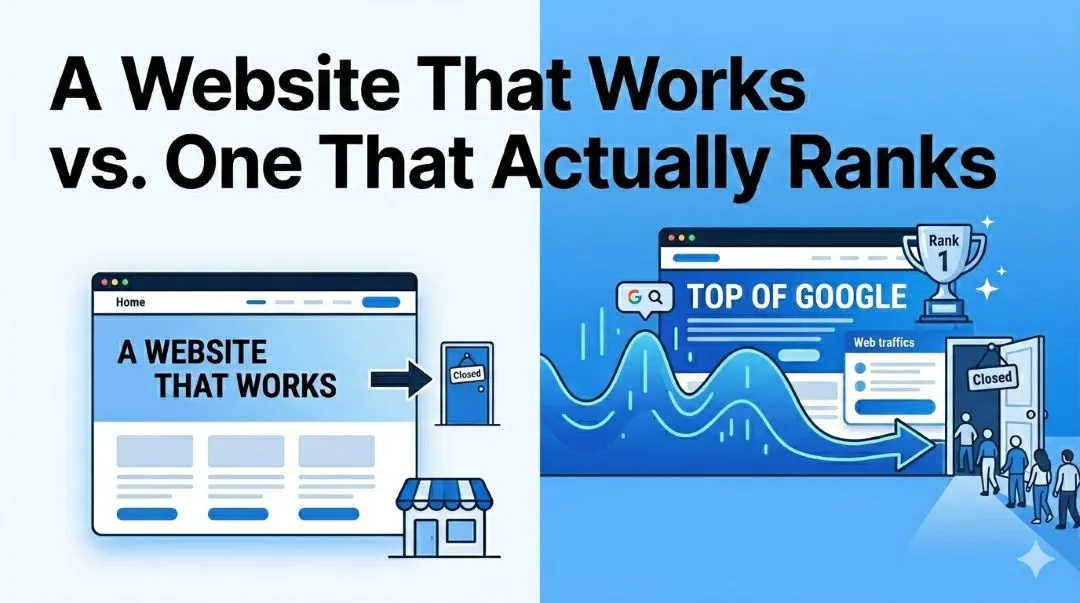
Table of Contents
- Checklist SEO: What Most People Think SEO Is
- Real SEO: What Actually Gets You on Page One
- Search Intent Match
- Keyword Strategy and Topical Depth
- Authority Signals and Backlinks
- Internal Linking and Site Architecture
- E-E-A-T: Experience, Expertise, Authoritativeness, Trustworthiness
- The Gap Nobody Talks About Enough
- What This Means Practically
- Frequently Asked Questions
- What's the difference between technical SEO and real SEO?
- Can I do real SEO myself or do I need an expert?
- How long does it take for real SEO to show results?
- Why do so many agencies only deliver checklist SEO?
- What's E-E-A-T and why does it matter?
- If I fix my checklist SEO, will my rankings improve?
If SEO was just meta tags, everyone would rank.
Seriously. If all it took was a meta title, a meta description, and a sitemap submission, then every business with a decent developer would already be on page one. Clearly, that's not how it works.
And yet, I keep seeing the same situation: a business owner gets a new website built, the developer says "I've handled the SEO," and six months later — no traffic, no rankings, no idea why.
The problem isn't the developer. The problem is that most people don't realize there are two completely different versions of SEO — and they've only been given one of them.
Checklist SEO: What Most People Think SEO Is
Checklist SEO is exactly what it sounds like. It's a list of technical boxes you tick when building or auditing a website. And to be fair — these things do matter. They're just not what gets you ranked.
Here's what checklist SEO typically covers:
Meta titles and descriptions. Adding a target keyword to your page title and writing a short summary for the search result snippet. Important for click-through, but Google has been auto-generating these when it thinks yours isn't good enough anyway.
Image alt text. Describing images for accessibility and crawlers. Good practice. Not a ranking lever.
XML sitemap. Telling Google which pages exist on your site. Helps with indexing. Doesn't influence rankings.
robots.txt. Telling crawlers what to ignore. Necessary for control. Not a growth strategy.
HTTPS and page speed. Secure connection and fast load times. Google confirmed these as ranking factors — minor ones, but real. A slow, insecure site will hurt you. A fast, secure one just meets the baseline.
Mobile responsiveness. Your site should work on phones. This is table stakes in 2025, not a competitive advantage.
Here's the hard truth about all of this: checklist SEO makes your website readable to Google. It does not make your website rankable. There's a difference — and it's massive.
I've written about how SEO scorecard plugins give you the same false sense of security. A perfect score on those tools means your checklist is clean. It says nothing about whether you'll rank for anything meaningful.
Checklist SEO is the floor. Most websites stop here. That's why most websites don't rank.
Real SEO: What Actually Gets You on Page One
Real SEO starts where the checklist ends. It's less about configuration and more about strategy — understanding what people are searching for, why they're searching for it, and building something that genuinely deserves to rank.
This is harder to explain in a bullet point list. But let me break it down.
Search Intent Match
Google's entire job is to match a searcher with the most relevant result. Not the most optimized page — the most relevant one.
Search intent is the why behind a query. Someone searching "best running shoes" wants a comparison. Someone searching "how to tie running shoes" wants instructions. Someone searching "buy Nike Air Zoom" wants a product page. Three different intents. Three completely different content types.
Checklist SEO puts a keyword in your title. Real SEO asks: does this entire page — its format, depth, structure, and tone — match what the person searching this term actually wants? If your content type doesn't match the intent, no amount of meta tag optimization will save you. What happens when search intent actually matches is a completely different story from just adding keywords to a page.
Keyword Strategy and Topical Depth
Real SEO doesn't target keywords randomly. It maps out what your audience searches across every stage of their journey — awareness, consideration, decision — and builds content to meet them at each point.
More importantly, Google now evaluates topical authority. It's not enough to write one good post about a subject. Google wants to see that your site covers a topic with genuine depth — multiple interconnected pages that collectively signal expertise. A site with 30 well-structured posts on a focused topic will outrank a site with 300 scattered posts almost every time.
This is a content strategy problem. The checklist has no answer for it. Getting your keyword research right from the start is what separates sites that slowly build authority from ones that publish endlessly without gaining traction.
Authority Signals and Backlinks
Here's something no checklist can give you: other websites vouching for yours.
Backlinks — links from other sites pointing to your content — remain one of the strongest signals Google uses to determine authority. A developer cannot build these for you. They come from creating content worth referencing, building relationships, getting featured in relevant places, and earning trust over time.
One quality backlink from a credible, relevant site does more for your rankings than a hundred perfectly optimized meta descriptions. This is also one of the most abused areas in SEO — understanding the backlink mistakes beginners make is as important as understanding what to do right.
Internal Linking and Site Architecture
Real SEO thinks about how your pages connect to each other — not just whether they exist. Internal links pass authority between pages, help Google understand your site's structure, and signal which content you consider most important.
This isn't something you set up once. It evolves as your content grows. Adding a new post means going back to older relevant posts and linking to it. Building content clusters means connecting related pages deliberately. I've seen firsthand what a proper internal linking strategy actually does to rankings — it's one of the most underrated and underused levers in real SEO.
E-E-A-T: Experience, Expertise, Authoritativeness, Trustworthiness
This one doesn't appear on any checklist because you can't configure it. E-E-A-T is Google's framework for evaluating whether a source deserves to rank — especially for topics that affect people's health, money, or safety.
It's built through: consistent, accurate, experience-backed content. A real author with a real track record. External mentions and citations. A site that has been around, earned trust, and demonstrated it knows what it's talking about.
You don't optimize your way into E-E-A-T. You build into it — slowly, consistently, through real work.
The Gap Nobody Talks About Enough
The reason so many businesses end up with a working website that doesn't rank is simple: they got checklist SEO and thought it was the whole picture.
Checklist SEO is fast. Real SEO is slow. Checklist SEO has clear deliverables. Real SEO has compounding results. Checklist SEO can be handed off to a developer. Real SEO requires ongoing strategy, content, and adjustment.
Understanding what a real SEO strategy actually includes is the first step toward knowing what questions to ask — and what to expect from whoever you're working with.
What This Means Practically
If you've had a website for 6–12 months with little to no organic traffic, the first question to ask isn't "is my site broken?" It's "did I ever go beyond the checklist?"
Check whether you have a real keyword strategy — not just keywords in titles, but a mapped-out plan for what your audience searches and why. Check whether your content actually matches search intent or just contains the right words. Check whether you're building any kind of authority or just publishing into a vacuum.
The checklist gets your website working. Real SEO gets it ranking. Both matter — but only one of them builds something that grows over time.
Frequently Asked Questions
What's the difference between technical SEO and real SEO?
Technical SEO — the checklist — makes your site accessible and readable to Google. Real SEO makes your site worth ranking. Technical SEO is a one-time setup that needs periodic maintenance. Real SEO is an ongoing strategy that evolves with your content, competition, and Google's algorithm.
Can I do real SEO myself or do I need an expert?
You can absolutely start on your own — learning keyword research, understanding search intent, and building content consistently are all learnable skills. The more competitive your industry, the more strategy and experience matters. But even basic knowledge of real SEO principles will put you ahead of most sites that stop at the checklist.
How long does it take for real SEO to show results?
Typically 3–6 months before you start seeing meaningful movement, and 6–12 months before it compounds into consistent traffic. The checklist can be done in a day. Real SEO is measured in months and years.
Why do so many agencies only deliver checklist SEO?
Because it's easier to package, deliver, and explain. Meta tags, site speed fixes, and sitemaps have clear deliverables and timelines. Content strategy, topical authority, and link building are harder to define and take longer to show results — which makes them harder to sell. Always ask any SEO provider specifically what their ongoing strategy looks like beyond the initial audit.
What's E-E-A-T and why does it matter?
E-E-A-T stands for Experience, Expertise, Authoritativeness, and Trustworthiness — Google's framework for evaluating whether a source deserves to rank, especially for sensitive topics. You build it through consistent, accurate, experience-backed content over time. It can't be optimized in a single session — it's the cumulative result of doing real SEO properly.
If I fix my checklist SEO, will my rankings improve?
Only if checklist issues are what's holding you back — which is rarely the main problem for most sites. If your site has crawl errors or is loading in 8 seconds, fixing those will help. But if your site is technically healthy and still not ranking, the problem is almost certainly in the real SEO layer: intent, content depth, authority, or keyword strategy.
Want help with your project? Get in touch .