New Website SEO vs Established Sites | Know The Difference
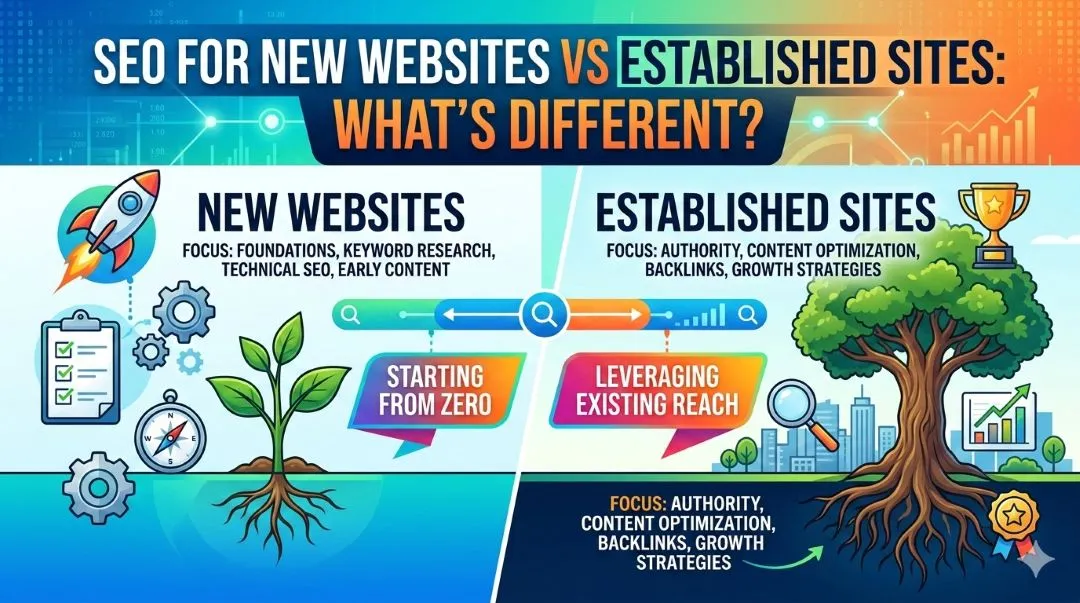
Table of Contents
- The Reality of Starting From Zero
- No Domain Authority to Lean On
- Keyword Competition Is a Real Wall
- Content Has No Internal Support
- You Have No Data to Work With
- What Established Sites Have That You Need to Build
- A Backlink Profile That Vouches for Them
- Topical Authority Built Over Time
- Engagement History Google Can Trust
- The Patience to Play the Long Game
- What This Means Practically
- Frequently Asked Questions
- How long does it take for a new website to compete with established sites?
- Should a new website avoid competitive keywords entirely?
- Can a new website outrank an established site?
- Is SEO strategy different for a new website vs an established one?
- What's the single most important thing for a new website's SEO?
When I first started doing SEO, I made the mistake of treating every website the same way.
Same strategy. Same priorities. Same expectations on timeline. It didn't take long to realize that was wrong — and the sites that suffered most from that thinking were the new ones.
A new website and an established website are not playing the same game. They have different problems, different advantages, different ceilings, and completely different starting points. Understanding that distinction early on changes how you approach everything — from the keywords you chase to the content you prioritize to the timeline you set for results.
Here's what I've learned about where those differences actually live.
The Reality of Starting From Zero
A new website starts with nothing Google can verify.
No ranking history. No backlink profile. No engagement data. No track record of content quality. Google has genuinely never seen you before — and as I covered in an earlier post about why Google doesn't trust new websites right away, that lack of history is the core reason rankings take time to appear.
But beyond trust, there are specific, practical challenges that make SEO harder in the early stages.
No Domain Authority to Lean On
Established sites have accumulated authority over months or years — through backlinks, consistent traffic, brand searches, and content that has proven its value to real users. That authority acts like a rising tide. A new post on an established site often ranks faster simply because Google already trusts the domain it lives on.
A new website has none of that. Every piece of content you publish starts from scratch. There's no authority cushion, no inherited trust, no signal history to lean on. You're asking Google to take a chance on you every single time.
This is why new websites often see their content sit unranked for weeks or months even when it's well-written and properly optimized. The content isn't the problem. The trust gap is.
Keyword Competition Is a Real Wall
Here's something I learned the hard way: new websites cannot compete for the same keywords as established sites — at least not immediately.
If a keyword has significant search volume, there are almost certainly established, authoritative sites already ranking for it. Going after those terms with a new domain is like entering a race three laps behind everyone else and wondering why you're not winning.
The keyword strategy for a new website has to be fundamentally different. You target long-tail, specific, lower-competition queries first — not because they're your end goal, but because they're winnable. Wins build authority. Authority eventually lets you compete for bigger terms. How to choose the right keywords walks through this selection process in detail — it's less about finding the highest-volume terms and more about finding the right entry points.
Content Has No Internal Support
An established site has an existing library of content. When a new post goes live, it can be internally linked from dozens of relevant existing pages — passing authority, signaling relevance, and giving Google multiple paths to discover and evaluate it.
A new website publishes its first ten posts into a vacuum. There's almost no internal linking structure because there's barely anything to link from or to. Each page is relatively isolated, which means Google has fewer signals about how your content relates to itself and what your site is really about.
This is why the early content strategy for a new site matters so much — not just what you publish, but how you build the connective tissue between posts from day one. The impact of getting this right is real — I documented it directly in this internal linking case study — and it's far easier to build intentionally from scratch than to fix it later.
You Have No Data to Work With
Established sites have months or years of Google Search Console data — they can see exactly which queries bring impressions, which pages have high click-through rates, which content is losing rankings and needs refreshing. That data is an enormous strategic advantage.
A new website is flying blind. You're making keyword and content decisions based on research and assumptions, not on what your site is already doing. It takes time before you accumulate enough data to start making informed adjustments — which means your early strategy needs to be patient and deliberate rather than reactive.
What Established Sites Have That You Need to Build
Understanding the challenges of a new website is really understanding what established sites have accumulated over time. And the good news is: none of it is permanently out of reach. It just takes time and the right approach to build it.
A Backlink Profile That Vouches for Them
Every credible external link pointing to an established site is a vote of confidence Google has already counted. Some of those links took years to earn. Collectively, they form an authority profile that new websites simply don't have yet.
Building this for a new site requires a different mindset. You're not trying to match an established site's backlink count in year one. You're trying to earn your first genuinely credible links — through content worth referencing, through building real relationships, through contributing value in your space. One link from a relevant, trusted source matters more than dozens of low-quality ones. I learned this firsthand — the SEO shortcuts I took and came to regret includes exactly the kind of backlink thinking that wastes early momentum.
Topical Authority Built Over Time
Established sites in a niche have often covered their subject from multiple angles, depths, and formats over years. Google recognizes this — a site that has consistently demonstrated expertise on a topic earns more trust for new content on that same topic.
For a new website, topical authority is built by being intentional about depth from the start. Rather than publishing broadly across many loosely related topics, the faster path to authority is going deep on a focused area first. Cover one subject thoroughly — from beginner questions to nuanced details — before expanding outward. This signals to Google that you actually know what you're talking about, not just that you're producing content.
Engagement History Google Can Trust
Established sites have real user engagement data — time on page, return visits, brand searches, click-through patterns across hundreds of pieces of content. Google uses these behavioral signals as one of many inputs when evaluating quality.
A new website has to earn this engagement data from scratch. Which means the content itself needs to be genuinely useful — not just optimized — from day one. Content that people actually read, share, and return to builds the engagement history that eventually becomes a trust signal. Why even perfect SEO content sometimes fails to rank gets into exactly this — engagement signals matter as much as optimization.
The Patience to Play the Long Game
This one isn't about Google — it's about mindset.
Established sites got to where they are because someone kept going when results were slow. The sites that fail in SEO almost always fail in the same way: they expect results too quickly, don't see them, and either stop publishing or start chasing shortcuts that make things worse.
The most honest thing I can tell you about SEO for a new website is this: the early months are the hardest, the least rewarding, and the most important. The work you do when nothing seems to be happening is exactly what determines where you end up six months later.
What This Means Practically
If you're running a new website, your SEO strategy should look noticeably different from what you'd do for an established site:
Target long-tail, low-competition keywords first. Build topical depth in a focused area before expanding. Prioritize internal linking architecture from your very first posts. Focus on content that genuinely earns engagement — not just content that's technically optimized. Be deliberate about earning backlinks rather than manufacturing them.
And set honest expectations. A new website competing with established ones is a long game. The gap is real — but it closes. Every credible backlink earned, every piece of content that earns real engagement, every month of consistent publishing narrows it.
The established sites you're competing with all started where you are now. The difference is they kept going.
Frequently Asked Questions
How long does it take for a new website to compete with established sites?
It depends heavily on your niche, content quality, and how actively you're building authority. In low-competition niches, meaningful rankings can appear within 3–6 months. In competitive spaces, it realistically takes 12–24 months before a new site can consistently challenge established players on significant keywords.
Should a new website avoid competitive keywords entirely?
Not forever — but initially, yes. Starting with long-tail, specific queries lets you build wins, accumulate authority, and establish topical depth before going after broader terms. Think of it as earning the right to compete for bigger keywords by proving yourself on smaller ones first.
Can a new website outrank an established site?
Yes — especially on specific, long-tail queries where the established site hasn't published dedicated content. Targeting gaps in their coverage is one of the smartest strategies for a new site. You're not trying to beat them everywhere — just find the angles they haven't covered well.
Is SEO strategy different for a new website vs an established one?
Significantly. An established site focuses on maintaining and expanding existing authority — refreshing old content, building on what's already ranking, protecting positions. A new site is in pure building mode — establishing topical authority, earning first backlinks, accumulating data, and targeting realistic keywords. Same discipline, very different priorities.
What's the single most important thing for a new website's SEO?
Consistency. Publishing quality content regularly, building internal links deliberately, and earning credible backlinks over time — done consistently over 6–12 months — will outperform any clever tactic applied sporadically. The compounding effect of consistent, patient work is what separates new sites that eventually rank from ones that never do.
Want help with your project? Get in touch .