SEO Internal Linking Case Study: How Strategic Linking Transformed Organic Traffic
2026-02-03 · 17 min read
SEO Internal Linking Case Study: How Strategic Linking Transformed Organic Traffic

Executive Summary

This case study demonstrates how a strategic internal linking approach, combined with intent-focused content creation, transformed a stagnant website into a high-performing organic asset. Starting from May 5, 2025 when I joined the agency, the resort website went from flat, minimal traffic to experiencing a dramatic growth spike in just 6 months—all accomplished without acquiring a single backlink.

Key Results:

  • Traffic transformation from flat baseline to exponential growth in 6 months
  • Massive traffic spike in November 2025 (month 6)
  • Sustained elevated performance continuing through January 2026
  • Average position: 11 on Google Search
  • Zero backlinks acquired during the campaign
  • Starting point: May 5, 2025 - flat, stagnant traffic with no growth

Client Background

Industry

Tourism and hospitality

Initial Website State (May 2025)

When I took over this client as my first SEO project in May 2025, the website had been live for over a year but showed a completely flat traffic pattern. Despite having 10 published blog posts, the site generated minimal organic traffic with no growth trajectory whatsoever. The Google Search Console graph showed a depressing horizontal line—month after month of stagnant performance with no signs of improvement.

This was my first real SEO challenge, and the flat traffic pattern made it clear: something fundamental was broken.

Initial Challenges & Problems Identified

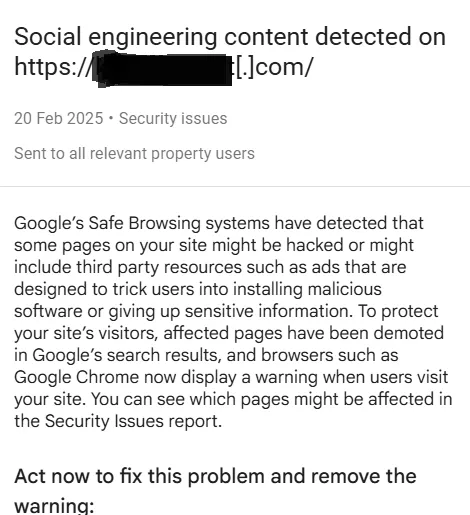
1. Security Crisis

The website was flagged for deceptive content by Google starting in February 2025. This security issue needed immediate attention but required coordination with the client and senior management, delaying resolution. image Img: Security Issue Notification

2. Search Intent Misalignment

Out of 10 existing blog posts, only one properly aligned with user search intent. The remaining nine posts missed the mark on what users were actually searching for, resulting in poor engagement and rankings. The client prioritized commercial and transactional content over informational queries that users needed.

3. NAP Inconsistency

The business had undergone a rebranding, but the Name, Address, and Phone (NAP) information remained inconsistent across the web. Major business listings and bookmarks still displayed the old business name, creating confusion for both search engines and users.

4. Thin Content Issues

Several important pages contained minimal content that failed to provide comprehensive value to visitors. This thin content problem prevented the site from competing effectively in search results.

5. Technical SEO Neglect

Basic optimization elements were missing across the site, including proper image alt text and fundamental on-page SEO elements that should have been standard practice.

6. Zero Growth Momentum

Perhaps most concerning was the complete lack of growth trajectory. The traffic pattern from April 2024 to May 2025 showed a flat line—no spikes, no growth, no indication that previous efforts were working. This suggested that whatever SEO strategy (if any) had been implemented before wasn't effective.

Strategic Approach & Implementation

Phase 1: Foundation Building (May 2025 - Week 4)

When I joined the agency on May 5, 2025, I inherited a website with a year of flat performance. As a newcomer to the SEO field, I recognized the importance of establishing credibility before requesting major changes. My initial approach focused on improvements I could implement independently:

Immediate Actions Taken:

  • Added descriptive alt text to all images
  • Update Metas with appropriate intent
  • Added relevant images in Blogs

Early Results: In the first month (May 2025), traffic remained mostly flat with only minor fluctuations. This was expected—SEO changes take time to manifest, and I was still learning the landscape.

Phase 2: Content Strategy Pivot

After gaining initial confidence and observing which changes produced results, I made a crucial decision: shift from following client topic suggestions to developing an intent-driven content strategy.

Content Philosophy Shift: Instead of creating promotional content that the client preferred, I focused on genuinely helping the audience by answering their real questions. This approach prioritized informational intent over commercial intent.

Topics Developed:

  1. Best Time to Visit Chitwan (rewritten to align with new strategy)
  2. Reasons to Visit Chitwan National Park
  3. Top 7 Facts About Chitwan National Park
  4. Packing List for Chitwan National Park
  5. How to Travel from Kathmandu to Chitwan
  6. How to Travel from Pokhara to Chitwan

Unintentional Topic Clustering: Interestingly, I created what I later realized was a topic cluster strategy without knowing the formal concept. These interconnected topics naturally supported each other, though I never received approval to create a comprehensive pillar page that would have strengthened this structure further.

Traffic Pattern (June-July 2025): During this phase, traffic began showing slight upward movement—nothing dramatic, but the flat line was starting to show small peaks and valleys. This suggested the content was beginning to gain traction, though we hadn't reached critical mass yet. image Img: June-July GSC Performance

Phase 3: The Internal Linking Breakthrough

The turning point in this campaign came when I discovered the power of strategic internal linking. This became the secret weapon that would eventually drive the traffic explosion.

Internal Linking Strategy:

Concept Understanding: I studied PageRank flow and how authority transfers between pages through internal links. The principle is simple but powerful: high-authority pages can pass their ranking power to other pages through strategic linking.

Implementation Methodology:

  1. Anchor Text Selection: I identified relevant, keyword-rich anchor text that naturally fit within the content while signaling to search engines what the linked page was about.
  2. Relevancy Matching: Every internal link connected topically related content. For example, the "Best Time to Visit Chitwan" article linked to "Packing List for Chitwan" and "How to Travel to Chitwan" where contextually appropriate.
  3. Link Placement Strategy: Rather than relegating links to footers or sidebars, I placed them contextually within the main content where they provided genuine value to readers and carried maximum SEO weight.
  4. Authority Flow Planning: I mapped which pages had the highest existing authority and created strategic linking pathways to flow that authority to newer pages I wanted to rank.

Traffic Pattern (August-October 2025): During these three months, traffic continued its gradual upward trajectory. The graph shows slightly higher peaks and the baseline was elevating, but we still hadn't seen the breakthrough. What was happening beneath the surface was critical: Google was recognizing the site's topical relevance, the internal linking structure was distributing authority effectively, and the content was building cumulative trust signals.

By October 2025, I could sense something was building. For the first time, I was able to hit the milestone of 1000 impressions on this site and I was so happy and excited to break it.

These small improvements were consistent, and search positions were gradually climbing for target keywords.

Phase 4: Content Promotion

After publishing each piece of content, I implemented a simple but effective promotion strategy:

  • Shared content across relevant social media channels
  • Leveraged the client's local business profiles
  • Engaged with tourism communities and forums (where appropriate)

This promotion helped build page-level authority even without traditional backlink outreach, as it generated initial traffic signals and social engagement that supported the content's credibility.

The Breakthrough: November 2025

The Traffic Explosion

After six months of consistent, strategic work, November 2025 marked the moment everything clicked. The Google Search Console graph shows what can only be described as a dramatic spike—traffic that had been flat for a year and gradually improving for six months suddenly shot upward.

Internal Linking Case Study Traffic Spike

What the Graph Shows:

  • April 2024 - April 2025: Completely flat line, minimal traffic
  • May 2025 (My Start Date): Still flat, but foundation building begins
  • June - October 2025: Gradual elevation with slight peaks
  • November 2025: DRAMATIC vertical spike in traffic
  • December 2025 - January 2026: Sustained elevated performance at the new higher baseline

Why the Spike Happened

This wasn't luck or a single factor—it was the convergence of multiple strategic elements reaching critical mass:

  1. Internal Linking Maturity: Six months of strategic internal linking created a web of authority distribution that Google finally recognized and rewarded.
  2. Topical Authority Recognition: The cluster of Chitwan-related content established the site as a relevant authority on this specific topic.
  3. Content Quality Threshold: Google's algorithms needed time to evaluate content quality, user engagement, and relevance. By November, enough data existed to confirm the content was valuable.
  4. Cumulative Trust Signals: Every optimization, every piece of content, every internal link contributed to building algorithmic trust. By month 6, trust reached the threshold where Google felt confident ranking the site higher.
  5. Seasonal Interest: November marks the beginning of peak tourism season for Chitwan National Park, amplifying the impact of our improved rankings.
  6. Algorithm Recognition: Google's algorithms likely re-evaluated the site around this time, recognizing the comprehensive improvements and rewarding them with significantly better visibility.

The Sustained Growth

What's equally important is what happened AFTER November. Rather than the spike being a temporary anomaly, traffic maintained its elevated position through December 2025 and January 2026, with continued growth. The graph shows the new baseline is dramatically higher than the pre-November level.

This sustained performance proves that the traffic increase was earned through legitimate SEO improvements, not a fluke or temporary algorithm change.

Results & Performance Analysis

The Transformation Timeline

Month 0 (May 5, 2025): Starting point - flat traffic pattern with no growth
Months 1-2 (May-June 2025): Minimal change, foundation building
Months 3-4 (July-August 2025): Slight upward movement beginning
Months 5-6 (September-October 2025): Gradual but consistent improvement
Month 6 (November 2025): BREAKTHROUGH - dramatic traffic spike
Months 7-8 (December 2025-January 2026): Sustained elevated performance with continued growth

Key Success Factors

1. Internal Linking as a Ranking Driver Without acquiring a backlink, the site achieved average position 11 ranking and dramatic traffic growth. This demonstrates that well-executed internal linking can effectively compete with sites that have stronger backlink profiles, particularly for local and informational queries.

2. Intent-Focused Content Strategy By prioritizing what users actually searched for rather than what the client wanted to promote, the content naturally attracted more organic traffic and engagement. This approach proved that understanding search intent is fundamental to SEO success. I've created a blog on search intent, you can check this link for detail

3. Consistent Publishing Schedule Regular content publication signaled to Google that the site was actively maintained and expanding its topical coverage. This consistency built algorithmic trust over time.

4. Topical Relevance Even without formal knowledge of topic clustering, creating interconnected content about Chitwan National Park established the site as a relevant authority on this specific subject.

5. Patience Through the "Flat" Period Perhaps most importantly, continuing to execute the strategy through months 1-5 when traffic remained relatively flat. Many would have given up or changed course, but staying consistent allowed the cumulative effects to manifest in month 6.

Challenges & Limitations Encountered

Client Communication Barriers

One of the most significant obstacles was the client's limited understanding of SEO principles and timeline expectations. They wanted immediate results but didn't fully appreciate the importance of:

  • Fixing the security issue promptly
  • Maintaining NAP consistency
  • Allowing creative freedom for content topics
  • Being patient with the SEO timeline (especially during months 1-4 when traffic remained flat)

Permission Restrictions

Several strategic opportunities remained unrealized due to lack of client approval:

  • Creating a comprehensive pillar page to anchor the topic cluster
  • Rebranding consistency updates across the web
  • Major website restructuring for better UX and SEO
  • Addressing thin content on commercial pages

Intent vs. Commercial Pressure

The client's preference for commercial and transactional content created ongoing tension with the informational intent strategy that was proving successful. Balancing client preferences with best practices required constant negotiation.

The "Patience Test"

The most difficult challenge was maintaining confidence and momentum during months 1-5 when traffic remained relatively flat. Without the hindsight of knowing the November spike was coming, it was challenging to convince stakeholders that the strategy was working. This period tested my resolve and required data-driven explanations of the incremental improvements happening beneath the surface.

What Could Have Been Done Better

1. Faster Topical Authority Development

With adequate budget and approvals, I would have implemented a more aggressive content strategy:

  • Target: at least 10 articles per month
  • Timeline: 3-month sprint to establish dominance
  • Coverage: Every aspect of Chitwan tourism, resort amenities, wildlife information, travel logistics, and visitor tips

This concentrated effort might have triggered the breakthrough spike in month 3-4 instead of month 6.

2. Backlink Acquisition

While the results without backlinks were impressive, adding a quality backlink profile would have accelerated growth significantly. Strategies that could have been employed:

  • Partnership with complementary tourism businesses
  • Link exchange with non-competing regional attractions
  • Guest posting on travel blogs and tourism websites
  • Digital PR to earn editorial mentions from travel publications
  • Creating linkable assets (comprehensive guides, infographics, interactive maps)

3. Pillar Page Architecture

Creating a comprehensive "Complete Guide to Chitwan National Park" pillar page would have:

  • Served as the authority hub for all supporting content
  • Provided a clear pathway for internal linking structure
  • Offered a high-value resource for link acquisition
  • Improved user experience with consolidated information
  • Potentially triggered the breakthrough spike earlier

4. Technical SEO Improvements

Addressing the foundational issues more aggressively:

  • Resolving the security issue within days, not months
  • Improving site speed and Core Web Vitals
  • Fix Breadcrumb navigation. (present: https//:<resortname>/<blog-title> instead of <resortname>/blogs/<blog-title>
  • Creating a more intuitive site architecture

5. Better Client Education

Investing more time in educating the client about SEO principles, timelines, and best practices would have:

  • Secured faster approvals for critical changes
  • Aligned expectations with realistic outcomes (especially about the 3-6 month timeline)
  • Reduced friction over content strategy
  • Built stronger long-term collaboration

6. Earlier Promotion Strategy

While I implemented content promotion, starting this earlier and more aggressively might have accelerated the timeline to breakthrough.

Key Learnings & Insights

1. Internal Linking is Underutilized

Most SEO discussions focus heavily on backlinks and technical optimization, but strategic internal linking proved to be a powerful ranking factor that many sites neglect. When executed properly with attention to relevancy, anchor text, and placement, internal links can drive dramatic traffic growth even in the absence of external links. Saying this, external links has a huge impact on SEO, so we cannot underestimate it.

2. Search Intent Trumps Promotion

Content created to genuinely help users consistently outperforms content created primarily to promote products or services. While commercial intent has its place, informational content builds trust, authority, and sustainable organic traffic.

3. SEO Has a "Critical Mass" Tipping Point

The November spike wasn't random, it represented the moment when cumulative improvements reached a threshold where Google's algorithms recognized the site deserved significantly better visibility. SEO improvements compound invisibly beneath the surface until they reach this tipping point, at which point growth accelerates exponentially.

This is why the timeline looked like: flat → flat → slightly up → slightly up → slightly up → EXPLOSION.

4. The 6-Month Timeline is Real

While every situation is different, this case study reinforces the common wisdom that significant SEO results often take 3-6 months to manifest. The key is understanding that months 1-5 aren't "not working"—they're building the foundation for month 6's breakthrough.

5. Don't Judge Success Too Early

If I had evaluated this campaign's success in month 3 or 4, it would have looked mediocre. The traffic was still relatively flat, and stakeholders were questioning the strategy. Patience and confidence in the fundamentals were essential to reaching the breakthrough moment.

6. Start Small, Build Confidence

As my first SEO client, starting with manageable improvements within my control built both my confidence and the client's trust. This foundation made it easier to advocate for bigger strategic changes later.

7. Visual Results Matter

The dramatic spike in the graph became my most powerful tool for demonstrating SEO value. Before November, explaining incremental improvements was challenging. After November, the graph spoke for itself. This visual proof transformed client relationships and expectations.

8. Topic Clustering Works (Even Accidentally)

Creating interconnected content about a specific topic naturally builds topical authority. While formal topic cluster strategies can optimize this further, even an intuitive approach to covering related subjects provides significant SEO benefits.

9. Persistence Through Flat Periods Wins

The most important success factor was continuing to execute the strategy consistently through the "flat" months when results weren't obvious. Many SEO efforts fail not because the strategy is wrong, but because stakeholders lose patience before reaching the breakthrough moment.

Recommendations for Similar Situations

For New SEO Professionals:

  1. Expect the flat period: Understand that months 1-5 might show minimal visible results while building critical foundations
  2. Document everything you observe and learn for future reference
  3. Focus on fundamentals like intent-matching and internal linking before advanced tactics
  4. Be patient with both results and your own learning curve
  5. Prepare stakeholders for the 3-6 month timeline and explain the compounding nature of SEO
  6. Advocate for users when client preferences conflict with best practices
  7. Use data to show incremental progress even when traffic appears flat

For Businesses with Limited Budgets:

  1. Prioritize internal linking as a high-impact, low-cost strategy
  2. Focus on quality over quantity when content budgets are tight
  3. Address technical issues first before investing in content creation
  4. Build topical authority in a specific niche rather than trying to compete broadly
  5. Commit to the 6-month timeline before evaluating success or failure
  6. Measure and communicate subtle improvements to maintain stakeholder buy-in
  7. Understand the tipping point concept and don't abandon strategies prematurely

For Client-Service Relationships:

  1. Set realistic expectations about the 3-6 month timeline upfront
  2. Educate clients proactively about SEO timelines and principles
  3. Show incremental progress even during flat periods (keyword position improvements, impressions growth, etc.)
  4. Celebrate small wins to maintain momentum and buy-in
  5. Document strategy and rationale for decisions to reduce future friction
  6. Push back respectfully when client preferences conflict with SEO best practices
  7. Use visual data to tell the story, especially after breakthrough moments
  8. Frame flat periods as "foundation building" rather than "not working"

Conclusion

This case study tells the story of SEO's true nature: a gradual, cumulative process that reaches a tipping point where results accelerate dramatically.

The Journey:

  • Inherited: A website with a year of flat traffic and failed SEO efforts
  • Built: Six months of strategic improvements with minimal visible results
  • Breakthrough: A dramatic traffic spike in month 6 that transformed the site's performance
  • Sustained: Continued elevated traffic establishing a new baseline

The Results: Starting from a completely flat traffic pattern in May 2025, strategic internal linking combined with intent-focused content creation triggered a dramatic traffic spike in November 2025—just six months later. This growth was sustained through January 2026 and beyond, with the site reaching an average position of 11 on Google, all without acquiring a single backlink.

What Made This Work:

  1. Strategic internal linking that distributes authority effectively throughout the site
  2. Intent-focused content creation that prioritized user needs over promotional goals
  3. Persistence through the flat period when results weren't obvious
  4. Topical clustering that established authority on Chitwan-related queries
  5. Patience and trust in fundamental SEO principles

As I continue working with this client and future projects, the lessons learned here will inform more sophisticated strategies that combine these proven tactics with backlink acquisition, advanced technical SEO, and comprehensive topical authority development. But the core insight remains: master the fundamentals, trust the process through the flat period, and the breakthrough will come.

Supporting Images* Internal Linking Case Study image image

Want help with your project? Get in touch or read about my SEO framework .