How I Update Old Content for SEO (Complete Process)
Table of Contents
- Step 1: Diagnose with Google Search Console
- Step 2: The "If It Ain't Broke, Don't Fix It" Rule
- Step 3: Understand the Content's Nature
- Step 4: Define the Optimization Objective
- Step 5: Research Phase—Finding What's Missing
- Step 6: Prepare a New Outline
- Step 7: Write and Publish
- Step 8: Request Indexing
- My Content Update Schedule
- Results I've Seen
Content optimization isn't a one-and-done task. Old blog posts need regular updates to maintain rankings and stay relevant. Over time, I've developed a systematic approach to updating old content that's helped me revive underperforming pages and maintain strong performers. Here's my complete process.
Step 1: Diagnose with Google Search Console
Everything starts with Google Search Console (GSC). Before making any changes, I need to understand how the content is currently performing.
I check several key metrics:
- Clicks and impressions over the last three months
- Current position for target keywords
- Click-through rate (CTR) trends
- Performance comparison between now and three months ago
GSC shows me the complete picture. Is the content getting impressions but no clicks? That's a meta description or title problem. Is it getting clicks but declining over time? That might signal outdated information or increasing competition.
This data-driven approach prevents me from wasting time updating content that doesn't need it.
Step 2: The "If It Ain't Broke, Don't Fix It" Rule
Here's something many SEOs miss: if content is performing well and showing stable or improving trends, I don't touch it. Seriously.
Too many people update content just because it's old, but age alone isn't a problem. If rankings are solid, clicks are steady or growing, and users are engaging with the content, why risk changing something that works?
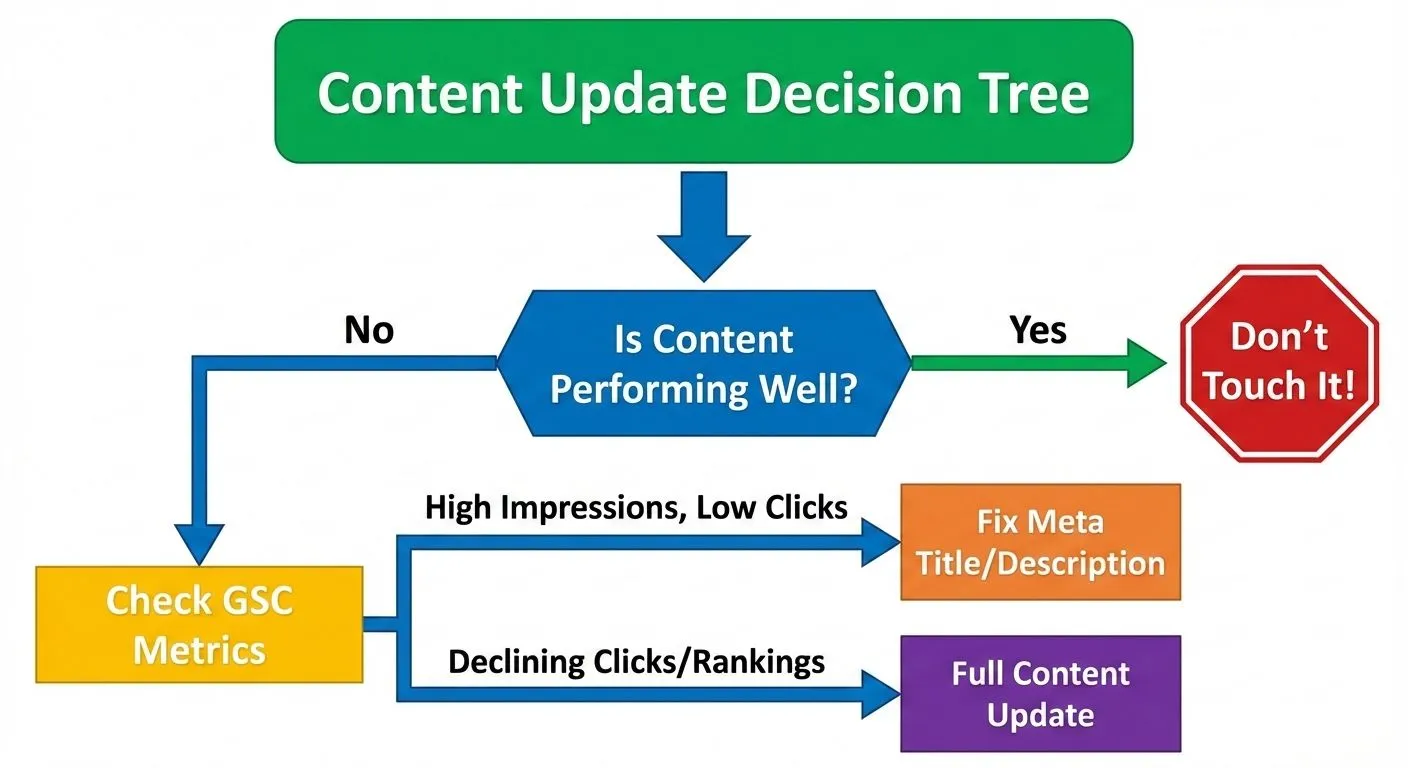
I only move forward with updates when I see clear warning signs: declining clicks, dropping impressions, or falling rankings.
Step 3: Understand the Content's Nature
Once I've identified underperforming content, I need to understand what type of content I'm dealing with. This determines my approach.
Is it seasonal or evergreen?
Some blog posts are inherently seasonal. A blog about "Best Dashain Gifts in Nepal" is only relevant during Dashain season. If it's not performing well in July, that's completely normal—it doesn't need urgent optimization.
However, if that same seasonal blog performed poorly during its actual season, then it needs work before the next season arrives.
Evergreen content—topics that are relevant year-round—gets immediate attention when performance drops. These should consistently generate traffic, so declining metrics mean something's wrong.
What's its current performance level?
I categorize content into three buckets:
- Performing well but could rank higher
- Underperforming but has potential
- Barely getting any traffic at all
This categorization helps me prioritize which content to update first and how aggressively to optimize it.
Step 4: Define the Optimization Objective
Before diving into research and rewrites, I clarify what I'm trying to achieve:
Rank higher for existing keywords? This means I need to expand the content, add more depth, cover subtopics competitors are covering, and improve the overall quality to outrank current top performers.
Just stay updated and maintain current rankings? This requires lighter touch—updating statistics, adding recent developments, refreshing examples, and ensuring information accuracy without completely overhauling the structure.
Having a clear objective prevents scope creep and keeps the update focused.
Step 5: Research Phase—Finding What's Missing
This is where the real detective work happens. I look for new keywords, updated information, and fresh angles to incorporate.
Google Search Console for keyword opportunities
GSC shows me keywords the page is already ranking for (position 11-30) but not on page one. These are low-hanging fruit—slight optimization could push them into top 10 positions.
I also look for related queries that are generating impressions. These reveal what users are actually searching for and what angles I might be missing. This is similar to the process I use when choosing keywords for new content, just applied to existing pages.
Competitor analysis
If I need to rank higher, I examine competitors who are outranking me. What are they covering that I'm not? What subtopics have they included? What questions are they answering?
I'm not copying their content—I'm identifying gaps in my own coverage. Understanding what happens when search intent matches your content is crucial here—if competitors are ranking higher, they're probably matching user intent better than I am.
Current trends and case studies
For topics that evolve quickly, I research the latest developments, new statistics, recent case studies, or updated best practices. This ensures my content reflects current reality, not outdated information.
For Nepal-specific content, I pay special attention to local developments, regulatory changes, or market shifts that might affect the topic.
Step 6: Prepare a New Outline
Based on my research, I prepare an updated outline. This step determines the scope of the update.
Sometimes the research reveals that the original structure is still solid—I just need to add a few new subheadings to cover emerging subtopics. Other times, I realize the entire approach is outdated and needs a complete restructure.
Minor update: Adding 2-3 new sections, updating statistics, refreshing examples, improving existing explanations.
Major overhaul: Reorganizing the entire piece, adding substantial new sections, removing outdated information, and essentially creating what feels like a new blog post that builds on the original foundation.
The outline guides my writing and prevents me from going off-track during the update.
Step 7: Write and Publish
With a clear outline and thorough research, the actual writing becomes straightforward. I update the content according to the plan—whether that's adding new sections, rewriting outdated parts, or refreshing the entire piece.
I make sure to:
- Update the publication date or add a "Last updated" notation
- Refresh meta titles and descriptions if needed
- Update or add relevant images with proper alt text
- Check that all internal links and external links still work
- Ensure the content flows naturally with additions integrated smoothly
Once everything is polished and ready, I hit publish.
Step 8: Request Indexing
This final step is crucial and often forgotten. After publishing the updated content, I immediately go to Google Search Console and request indexing for that specific URL.
Why? Because Google needs to know the content has changed. Without an index request, it might take weeks before Google recrawls the page and recognizes the updates. The manual request speeds up this process significantly.
I've seen updated content start showing improved rankings within days of indexing, compared to weeks when I forgot this step.
My Content Update Schedule
I don't update all old content at once. Instead, I work through it systematically:
- Monthly: Review top 20 performing posts for accuracy
- Quarterly: Deep dive into underperforming content with potential
- Seasonally: Prepare seasonal content before its relevant period
- Ongoing: Update content immediately when major industry changes occur
This schedule ensures content stays fresh without overwhelming my workflow.
Results I've Seen
This systematic approach has helped me:
- Recover rankings for posts that had dropped from page one to page three
- Increase organic traffic to updated posts by 50-150%
- Improve CTR by refreshing outdated meta descriptions
- Rank for new keyword variations without creating entirely new content
The key is being strategic—not every old post needs updating, but the right updates at the right time can breathe new life into your content and improve overall site performance.
One thing I've learned from my SEO journey is that content optimization requires patience and consistency. You won't see overnight results, but the compound effect of regularly maintained content creates sustainable organic growth.
Content optimization is an ongoing process, not a one-time task. Treat your published content like a garden that needs regular tending, and you'll see sustained SEO growth over time.
Want help with your project? Get in touch .