What SEO Can and Cannot Do
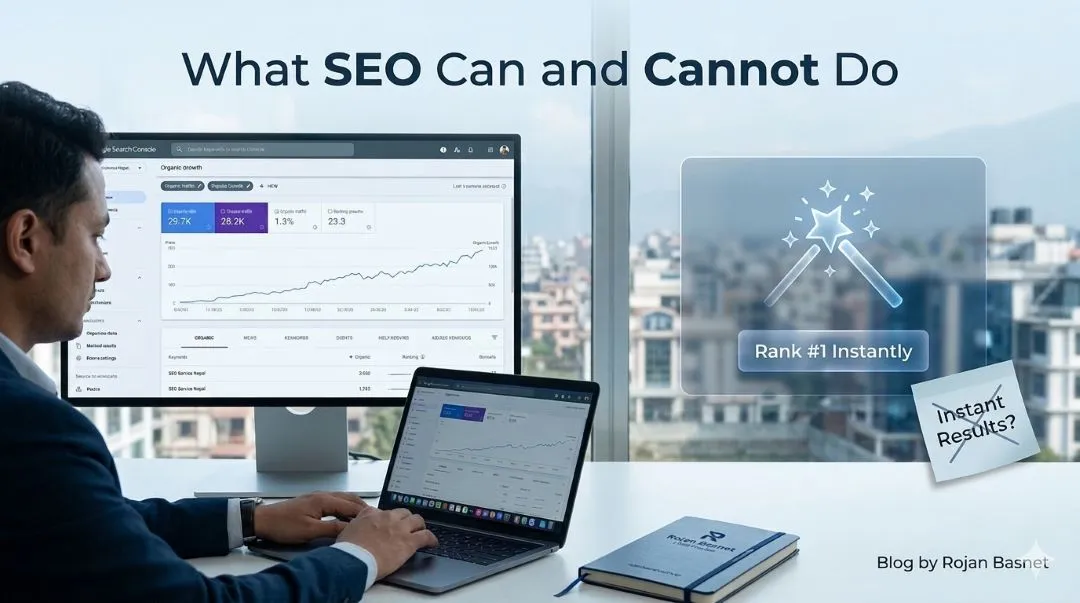
Table of Contents
- What SEO Actually Does
- What SEO Can Do for Your Business
- Increase Your Visibility in Google Search Results
- Bring Targeted, High-Quality Traffic
- Build Long-Term Traffic That Compounds
- Improve Your Website's Structure and User Experience
- Strengthen Your Local Online Presence
- What SEO Cannot Do
- SEO Cannot Guarantee #1 Rankings
- SEO Cannot Deliver Instant Results
- SEO Cannot Fix a Poor Product or Service
- SEO Cannot Replace Your Entire Marketing Strategy
- Why Unrealistic SEO Promises Exist
- When SEO Works Best
- When SEO Might Not Be the Right Move Right Now
- SEO Is Powerful, But It's Not Magic
- Frequently Asked Questions
- How long does SEO actually take to show results?
- Can any SEO agency guarantee first-page rankings?
- Is SEO worth it for small businesses?
- Does SEO work without social media?
- What's the difference between SEO and paid ads?
A lot of businesses come to SEO expecting a miracle. They invest money, wait a few weeks, and then wonder why they're not on the first page of Google. Some agencies make it worse by promising things like "#1 rankings in 30 days" or "guaranteed first-page results." That kind of talk sets people up for disappointment.
Understanding what SEO can and cannot do isn't a pessimistic thing to say. It's actually the most honest starting point before you put time or money into it. I've seen businesses get burned because expectations were completely off from reality and I've been guilty of overpromising in my early days too.
So let me break this down clearly.
What SEO Actually Does
SEO — search engine optimization — is the process of making your website easier for search engines like Google to understand, and easier for people to find when they're searching for something relevant to your business.
It works through three main areas: content (what your pages say and how relevant they are), technical optimization (how well your site is built and structured), and backlinks (how many credible websites link back to yours). Search intent — understanding why someone is searching — ties all three together.
If you want a clearer picture of the fundamentals, my SEO glossary covers terms like organic traffic, backlinks, and search intent in plain language.
What SEO Can Do for Your Business
Increase Your Visibility in Google Search Results
When someone types a query into Google, SEO is what determines whether your website shows up — and where. A well-optimized page targeting the right keywords has a real chance of appearing in front of people who are actively looking for what you offer.
That's the core promise of SEO: visibility to the right audience at the right moment.
Bring Targeted, High-Quality Traffic
This is one of the most underrated benefits. SEO doesn't just bring random visitors, it brings people who are already searching for what you do.
Someone searching "Luxury Hotel in Kathmandu" isn't casually browsing. They need something. That intent makes SEO traffic genuinely valuable compared to, say, a random Facebook ad impression.
Build Long-Term Traffic That Compounds
One thing I genuinely love about SEO is that it works like a compounding asset. A well-written, well-optimized page can bring consistent traffic for months — sometimes years — after you publish it.
Paid ads stop the moment you stop paying. Organic traffic from SEO doesn't work that way. That's a meaningful difference when you're thinking about long-term growth rather than just short-term spikes.
Improve Your Website's Structure and User Experience
Good SEO and good user experience overlap more than people realize. Optimizing a site for search engines usually means improving page speed, fixing broken links, improving mobile usability, and building a cleaner internal link structure.
These changes help both Google and your actual visitors. It's not one or the other.
Strengthen Your Local Online Presence
If you run a local business, SEO can help you show up in local search results and Google Maps. Optimizing your Google Business Profile is one of the most direct ways to improve local visibility — and it's often an underused opportunity for small businesses.
What SEO Cannot Do
This part matters just as much. Honest SEO professionals talk about limitations. Anyone who skips this section is either naive or not being straight with you.
SEO Cannot Guarantee #1 Rankings
No one can promise you the first spot on Google. Not me, not the most experienced agency in the world. Even engineers of Google.
Google's algorithm considers hundreds of signals. Competition, domain authority, content quality, user behavior data, backlink profiles — all of it plays a role. Even if you do everything right, a competitor with more resources and a stronger site might still outrank you. That's just the reality.
If an agency or freelancer is promising guaranteed rankings, that's a serious red flag that you should never believe. Ask for a clear roadmap on how they're gonna work on your website.
SEO Cannot Deliver Instant Results
SEO takes time. Google needs to crawl your pages, evaluate your content, assess your authority, and compare you against existing competitors. That process doesn't happen overnight.
A realistic timeline is 3–6 months before you start seeing meaningful movement — and that's for less competitive keywords. Competitive industries can take much longer. I wrote about why new websites don't rank on Google immediately if you want a deeper look at why the waiting period is normal, not a failure.
SEO Cannot Fix a Poor Product or Service
SEO can bring people to your website. It cannot make them stay, trust you, or buy from you if your offering isn't right.
If your reviews are bad, your product is weak, or your service falls short — SEO will just bring more people to a business that isn't ready for them. Traffic without conversion is just a vanity metric. To avoid this, work on your service or product and hire a good copywriter to optimize for converting traffic into valuable customers.
SEO Cannot Replace Your Entire Marketing Strategy
This one comes up a lot. SEO is powerful, but it works best alongside other efforts — branding, social media, email marketing, customer experience. It's one channel, not the whole system.
I've seen businesses treat SEO like a silver bullet and neglect everything else. That rarely ends well. SEO supports a strong marketing strategy; it doesn't substitute for one.
Why Unrealistic SEO Promises Exist
The SEO industry has a credibility problem that it created itself.
Agencies promising "page one in 7 days" or "100% guaranteed rankings" aren't lying because SEO is dishonest — they're lying because it's a competitive industry and fear-based sales tactics work on people who don't understand how SEO actually functions.
The hard truth? If someone understood SEO well enough to evaluate those claims critically, they'd immediately see through them. That's why the promises target the knowledge gap, not the actual service.
Trustworthy SEO work is boring to sell. It's "this will take 4–6 months and here's how we'll measure progress." That's not as exciting as "page one in 30 days," but it's what actually works.
When SEO Works Best
SEO delivers the strongest results in specific situations:
- Your business has clear services that people actively search for
- You're willing to invest in quality content consistently
- You're playing a long game and aren't expecting instant returns
- Your website is technically sound (or you're willing to fix it)
- You already have some brand credibility to build from
The businesses that see the most from SEO are the ones that treat it as an ongoing investment, not a one-time fix.
When SEO Might Not Be the Right Move Right Now
Not every business should prioritize SEO at every stage.
If you have a brand new product that nobody is searching for yet, organic search won't help much — there's no demand to capture. If you need immediate sales this month, paid ads will move faster. If you're testing a business idea and not yet sure about your offer, SEO is probably not the priority.
That doesn't mean SEO is off the table forever. It just means timing matters. For some businesses, understanding whether your website actually works before investing in SEO is the smarter first step.
SEO Is Powerful, But It's Not Magic
Here's what I'd want every business owner to walk away with: what SEO can and cannot do comes down to understanding its real nature.
It's not a shortcut. It's not a guarantee. It's a long-term strategy that builds compounding visibility for businesses that are patient, consistent, and realistic about the timeline.
When done right — with honest expectations, quality content, and technical fundamentals in place — SEO becomes one of the most sustainable ways to grow online. But like any strategy, it only works when the expectations match the reality.
If you're curious about how to approach SEO without getting caught up in myths and shortcuts, my overview of common SEO terms is a good place to get grounded before you dive deeper.
Frequently Asked Questions
How long does SEO actually take to show results?
Most websites start seeing noticeable improvement in 3–6 months for less competitive keywords. For more competitive industries, it can take 9–12 months or longer. The timeline depends on your domain's existing authority, competition level, and how consistently you're creating quality content.
Can any SEO agency guarantee first-page rankings?
No legitimate agency can guarantee a specific ranking position. Google's algorithm is too complex and constantly changing for anyone to make that promise honestly. If an agency is guaranteeing rankings, treat it as a warning sign — not a selling point.
Is SEO worth it for small businesses?
Yes, especially for local businesses. Local SEO — appearing in map results and local search queries — is one of the most accessible and cost-effective strategies available. The investment required is lower than many paid channels, and results tend to last longer.
Does SEO work without social media?
SEO and social media are separate channels, and SEO can generate traffic without social media. However, combining both tends to produce stronger overall results. Social media can drive early traffic to new content, which can indirectly support SEO over time.
What's the difference between SEO and paid ads?
Paid ads deliver traffic immediately but stop the moment you stop spending. SEO takes longer to build but continues generating traffic without ongoing ad spend. Most businesses benefit from using both depending on their goals and timeline.
Want help with your project? Get in touch .