Common SEO Terms Explained Simply
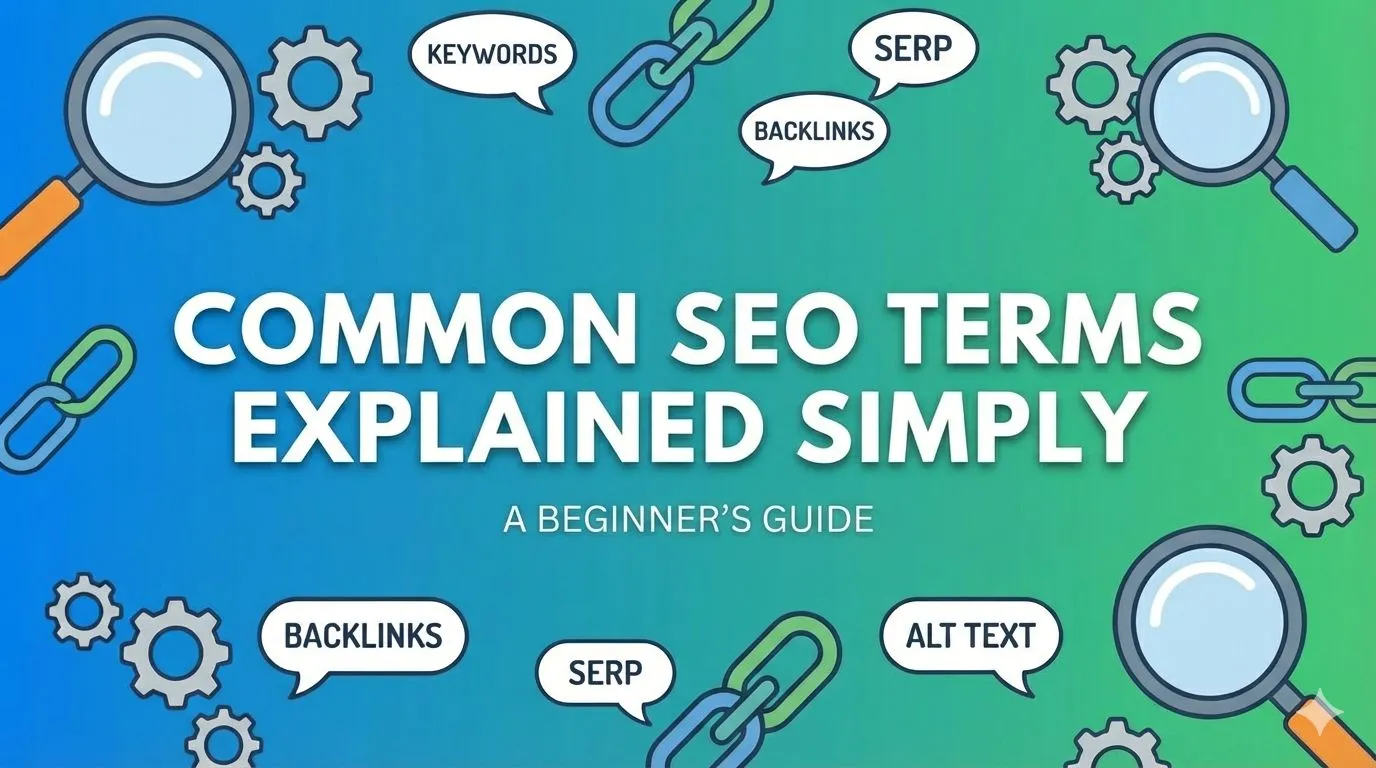
Table of Contents
- Why Business Owners Need to Understand Basic SEO Terms
- Core SEO Terms Every Business Owner Should Know
- What Is SEO?
- Search Engine Results Page (SERP)
- Keywords
- Search Intent
- Organic Traffic
- On-Page SEO Terms
- Title Tag
- Meta Description
- Headings (H1, H2, H3)
- Internal Links
- URL Slug
- Off-Page SEO Terms Business Owners Hear Often
- Backlinks
- Domain Authority (DA)
- Anchor Text
- Citations (For Local Businesses)
- Technical SEO Terms
- Crawling & Indexing
- Site Speed
- Mobile-Friendly
- HTTPS / SSL
- SEO Metrics
- SEO Terms You Can Safely Ignore (At First)
- How Knowing These SEO Terms Helps You Grow Your Business
- Final Thoughts
If you've ever felt lost in a meeting with an SEO agency, nodding along while internally panicking about what "meta descriptions" or "domain authority" actually mean? You're not alone.
SEO jargon can feel like a foreign language designed specifically to make business owners and beginners who just started out.
Here's the thing: you don't need to become an SEO expert to make smart marketing decisions. But knowing the basics? That's the difference between getting real results and throwing money at vanity metrics that sound impressive but don't move the needle on revenue.
This guide breaks down the most common SEO terms you'll hear—without the technical fluff. We're talking about rankings, traffic, leads, and ultimately, ROI. Think of this as your translation guide for understanding what your SEO team is actually doing and whether it's worth your investment.
Why Business Owners Need to Understand Basic SEO Terms
You wouldn't sign a contract without reading it, right? Same principle applies to SEO.
Understanding SEO basics for business owners isn't about doing the work yourself—it's about being an informed buyer.
When you know SEO terminology, three things happen:
First, you can actually communicate with your SEO agency or freelancer. Instead of just saying "I want more traffic," you can ask, "What's our strategy for targeting commercial intent keywords?" That's a conversation that leads to results.
Second, you protect yourself from overpromises. An agency promising "page one rankings in 30 days" or obsessing over metrics like Domain Authority sounds great until you realize those don't necessarily translate to paying customers. Knowledge is your BS detector.
Third, you make better marketing decisions. When you understand what moves the needle, you can allocate budget wisely and evaluate whether your SEO investment is actually working.
Bottom line: SEO basics for business owners aren't about becoming the expert—they're about becoming the smart client who gets better results.
Core SEO Terms Every Business Owner Should Know
What Is SEO?
Let's start simple. SEO (Search Engine Optimization) is the practice of improving your website so it shows up when potential customers search for what you offer on Google.
Think of it this way: if your business isn't on page one of Google for relevant searches, you're invisible to most potential customers.
What is SEO at its core? It's about visibility, which leads to traffic, which leads to leads, which leads to revenue. Everything else is just tactics to make that happen.
Search Engine Results Page (SERP)
The SERP meaning is straightforward—it's literally the page of results Google shows you after you search for something.
Here's what matters: page one gets nearly all the clicks. Page two? Might as well not exist.
On that first page, you'll see organic results (the regular listings) and paid ads (marked as "Sponsored"). Organic is free traffic you earn through SEO. Ads are traffic you pay for immediately.
For most businesses, showing up organically on page one for your key terms is worth more than almost any other marketing investment.
Keywords
When we talk about SEO keywords explained for business purposes, we're talking about the actual phrases your customers type into Google when they need what you sell.
Business keywords come in two main types:
Short-tail keywords are broad searches like "Agency" or "accounting software." High search volume, but super competitive and often not ready to buy.
Long-tail keywords are specific phrases like "SEO Agency in Kathmandu" or "accounting software for small construction companies." Lower search volume, but these people know exactly what they want—and they're much more likely to become customers.
For most businesses, long-tail keywords are where the money is. If you want to go beyond just understanding keywords and actually start finding the right ones for your business, my guide on how to choose the right keywords walks you through exactly how I do it.
Search Intent
Understanding keyword intent explained simply: not all searches are created equal. Someone searching for information is in a completely different headspace than someone ready to hire.
Informational intent: "how to fix a leaky faucet" (they want to learn)
Commercial intent: "best plumbers in Austin" (they're researching options)
Transactional intent: "emergency plumber near me" (they need help NOW)
Match your content to the intent, and you'll actually convert traffic into revenue.
I wrote about a real example of this — see what happened when search intent actually matched on one of my pages and how it changed the results.
Organic Traffic
Organic traffic meaning is simple: visitors who find your website through unpaid search results. They Googled something, saw your listing, clicked, and landed on your site.
The difference between paid ads and organic? Ads stop working the second you stop paying. Organic traffic, once you've built it up, keeps delivering results month after month without additional ad spend. It's the closest thing to a marketing annuity.
On-Page SEO Terms
Title Tag
The title tag SEO element is the blue clickable headline you see in Google results. It's the first impression potential customers get of your page.
Why it matters: a compelling title tag dramatically improves your click-through rate. Think of it as the subject line of an email—boring titles get ignored, clear and compelling ones get clicked.
Meta Description
Meta description SEO is basically sales copy in Google. It's the short blurb under your title tag that summarizes what's on the page.
Google doesn't use meta descriptions for rankings, but they absolutely influence whether people click on your result or your competitor's. Write them like mini ads for your page.
Headings (H1, H2, H3)
Heading tags SEO isn't complicated: H1 is your main headline, H2s are section headers, H3s are subsections. Think of them like an outline from school.
For business owners, here's all you need to know: clear headings make your content scannable for readers and help Google understand what your page is about. Don't overthink it—just organize your content logically.
Internal Links
Internal linking SEO means linking from one page on your website to another page on your site.
Why it matters: it helps spread authority throughout your site (so your important pages rank better) and guides visitors through a logical journey. If someone reads your blog post about kitchen remodeling, an internal link to your kitchen design services page is how you turn a reader into a lead.
I documented exactly how much this matters in my internal linking case study — the numbers surprised even me.
URL Slug
An SEO friendly URL is clean and descriptive.
Good: yoursite.com/emergency-plumbing-services
Bad: yoursite.com/page?id=12394&cat=svc
Simple URLs are easier for people to remember and trust, and they give Google another signal about what your page covers.
Off-Page SEO Terms Business Owners Hear Often
Backlinks
Backlinks explained simply: when another website links to yours, that's a backlink. Think of it like a recommendation.
If a respected home improvement blog links to your plumbing company's website, Google sees that as a vote of confidence. More quality backlinks = higher rankings. It's that straightforward.
But before you start building any, read about the backlink mistakes SEO beginners should avoid — some of these can actually hurt you.
Domain Authority (DA)
Domain authority meaning gets thrown around a lot. It's a score (0-100) created by a company called Moz that predicts how well a site might rank.
Here's the critical part: it's a third-party metric, not a Google ranking factor. Don't obsess over it. Think of DA like a rough estimate of your website's reputation—useful context, but not the actual goal.
Anchor Text
Anchor text SEO is the clickable text in a link. If I write "check out our plumbing services" and link those words, that's anchor text.
Natural anchor text varies—sometimes it's your brand name, sometimes descriptive, sometimes just "click here." Spammy links all use the exact same keyword-stuffed anchor text over and over. Google can tell the difference.
Citations (For Local Businesses)
For local businesses, local SEO citations matter. A citation is any online mention of your business name, address, and phone number (NAP).
The key is consistency. If you're "ABC Plumbing LLC" on your website but "ABC Plumbing" on Yelp and "A.B.C. Plumbing, LLC" on the Better Business Bureau, that confusion hurts your local rankings. Keep your NAP identical everywhere.
Technical SEO Terms
Crawling & Indexing
Crawling vs indexing explained: Google sends out little programs (bots) to "crawl" websites, reading the content and following links. Once Google understands a page, it adds it to its index (basically a massive database of web pages).
If your page isn't indexed, it can't rank. Think of it like: crawling is Google discovering your page, indexing is Google filing it away for future searches.
Site Speed
Page speed SEO directly impacts conversions. Every second your site takes to load, you lose potential customers.
Google knows this, so faster sites rank better. But more importantly, a slow website kills your bounce rate—people leave before even seeing what you offer. Speed isn't just an SEO thing; it's a business fundamentals thing.
Mobile-Friendly
Mobile SEO matters because most searches now happen on phones. Google's "mobile-first indexing" means they primarily judge your site based on the mobile version.
If your site looks terrible or doesn't work on a phone, you're not ranking well. Period.
HTTPS / SSL
HTTPS SEO is about security. That little padlock in your browser's address bar? That's HTTPS.
Google gives HTTPS sites a slight ranking boost, but more importantly, modern browsers warn users about non-secure sites. Trust matters in business, and HTTPS is part of building that trust online.
SEO Metrics
Let's talk numbers that matter. SEO metrics for business owners should focus on outcomes, not vanity.
Impressions show how often your site appeared in search results. Nice to know, but doesn't pay the bills.
Click-Through Rate (CTR) is the percentage of people who saw your result and clicked. Higher CTR means your titles and descriptions are working.
Conversions are the actions that matter—form submissions, phone calls, purchases. This is where SEO KPIs get real.
Leads & Revenue are what you actually care about. Not just rankings. Who cares if you rank #1 for a keyword if it brings zero paying customers?
SEO Terms You Can Safely Ignore (At First)
Here's some honest talk about SEO myths: you'll hear people obsess over keyword density percentages, argue about exact match anchor text ratios, or freak out about Google's "200+ ranking factors."
For unnecessary SEO metrics, here's what you can ignore early on:
- Keyword density (just write naturally)
- Exact match anchor obsession (variety is natural)
- Stressing over every Google update
Focus on the fundamentals first. The advanced stuff only matters once you've mastered the basics.
How Knowing These SEO Terms Helps You Grow Your Business
Understanding SEO for business growth comes down to this: better decisions lead to better ROI.
When you know what matters, you don't waste money chasing vanity metrics. You don't get sold on snake oil promises. You build an SEO strategy for business owners that's grounded in reality and focused on revenue.
You become the client who asks the right questions, measures the right metrics, and actually gets results from your marketing investment.
Final Thoughts
Look, SEO has depth. You could study it for years and still find new things to learn. But you don't need to know everything to make it work for your business.
Master these fundamentals. Use them to have smarter conversations with your marketing team. Focus on the metrics that matter—leads and revenue, not vanity rankings.
SEO isn't magic, and it's not a mystery. It's a logical, systematic, proven way to get found by the people who need what you sell. Start with these terms, apply them to real business decisions, and you'll be miles ahead of competitors who treat SEO like a black box.
Want help with your project? Get in touch .