Local SEO for Small Business in Nepal: A Practical Guide
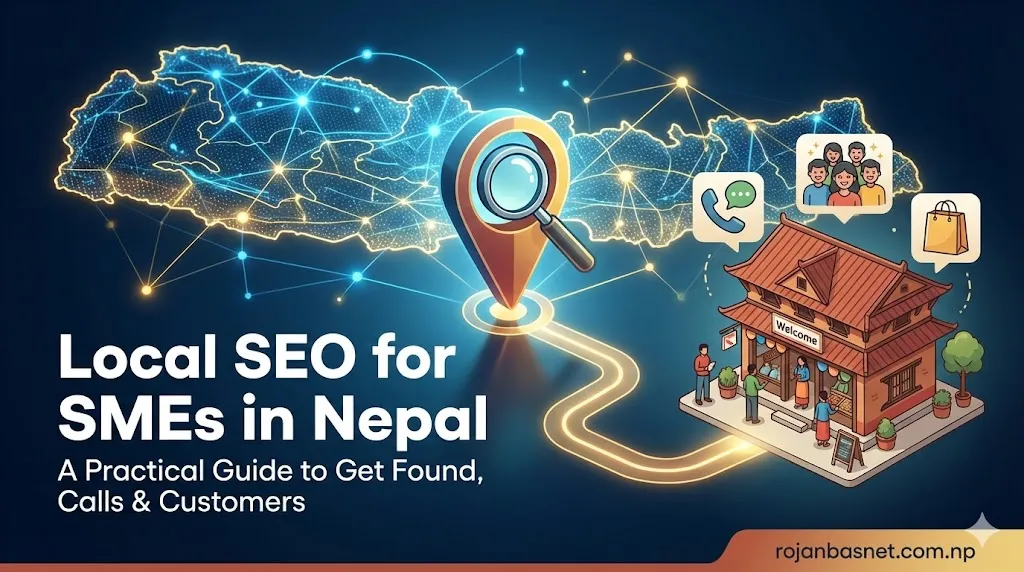
Table of Contents
- What Is Local SEO?
- Why Local SEO Matters
- How Google Ranks Local Businesses
- Google Business Profile Optimization
- Essential Optimization Steps
- Local Keyword Research
- Service + Location Keywords
- Quick Keyword Research Tactics
- On-Page SEO for Local Service Pages
- Homepage Essentials
- Service Page Structure
- NAP Consistency
- Service Areas
- Technical Essentials
- Local Citations and NAP Consistency
- Common Citation Sources in Nepal
- The Critical Rule
- Focus on Quality Over Quantity
- Reviews and Reputation Management
- Why Reviews Matter
- How to Get Reviews Ethically
- What NOT to Do
- Common Local SEO Mistakes
- How Long Does Local SEO Take?
- Factors Affecting Speed
- Local SEO Checklist
- Google Business Profile
- Website
- Reviews
- Citations
- Tracking
- Measuring Success
- What to Track
- How to Track Results
- Setting Realistic Goals
- DIY vs Hiring an Expert
- DIY Makes Sense If:
- Hire a Professional If:
- What to Look For:
- Frequently Asked Questions
- Will local SEO work in smaller cities outside Kathmandu?
- What if competitors have fake reviews?
- Do I need a website or just GBP?
- How often should I post on Google Business Profile?
- Can I rank for multiple cities?
Being invisible online means losing customers to competitors across the street. I've worked with businesses in Nepal that were completely invisible in local searches until we fixed their online presence.
Local SEO isn't about chasing traffic numbers. It's about showing up when someone in Kathmandu, Pokhara, or Lalitpur is ready to hire, buy, or visit your business.
This guide is for Nepali service businesses, local shops, restaurants, medical practices, training centers, and any SMB that depends on customers finding them locally.
What Is Local SEO?
Local SEO optimizes your online presence so your business appears when people search for services in a specific area.
When someone searches "best momo restaurant near me" or "dentist in Lalitpur," local SEO determines which businesses appear.
Examples of local searches:
- "Gym near Baneshwor"
- "CA coaching classes in Kathmandu"
- "Dermatologist in Lalitpur"
- "Laptop repair Thamel"
- "Plumber in Bhaktapur"
These searches represent high intent—people ready to visit, call, or book. Understanding search intent is crucial—get it wrong, and you won't show up when it matters.
Why Local SEO Matters
Local searches drive immediate decisions. Someone looking for "IELTS Class Near Me" will contact the first qualified business they find.
Two main local search result types:
Google Maps Pack: The top 3 businesses with map pins. Prime real estate—you're visible before any website links. Most mobile users never scroll past this.
Organic Local Results: Traditional website listings below the Maps Pack.
I recently worked with a Resort of Chitwan that was struggling with being visible in local searches. Within 3 days of optimizing their Google Business Profile, they started receiving 15-20 calls per week directly from Google Search. In January of 2026, they received 331 calls. 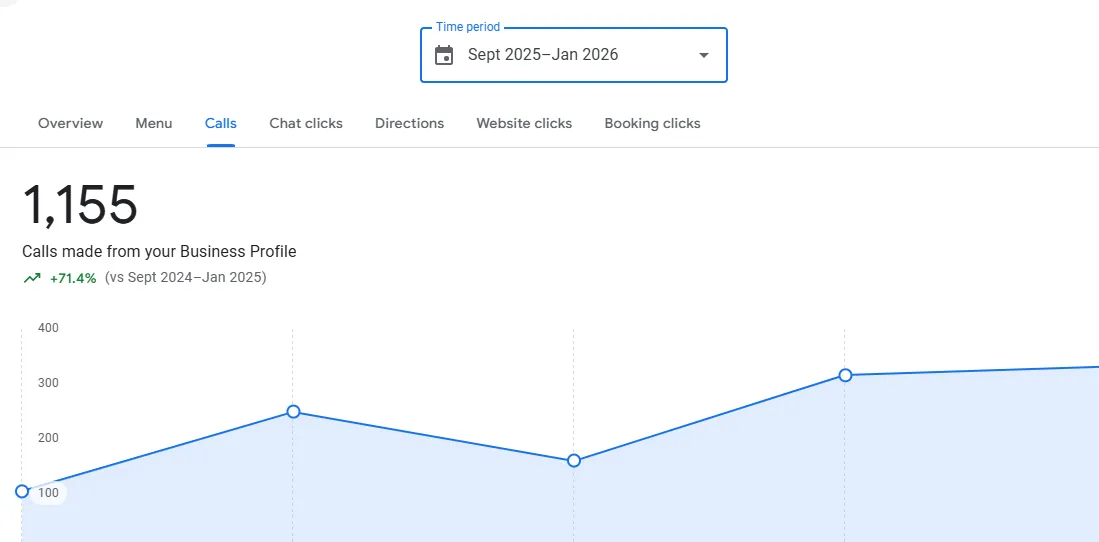
How Google Ranks Local Businesses
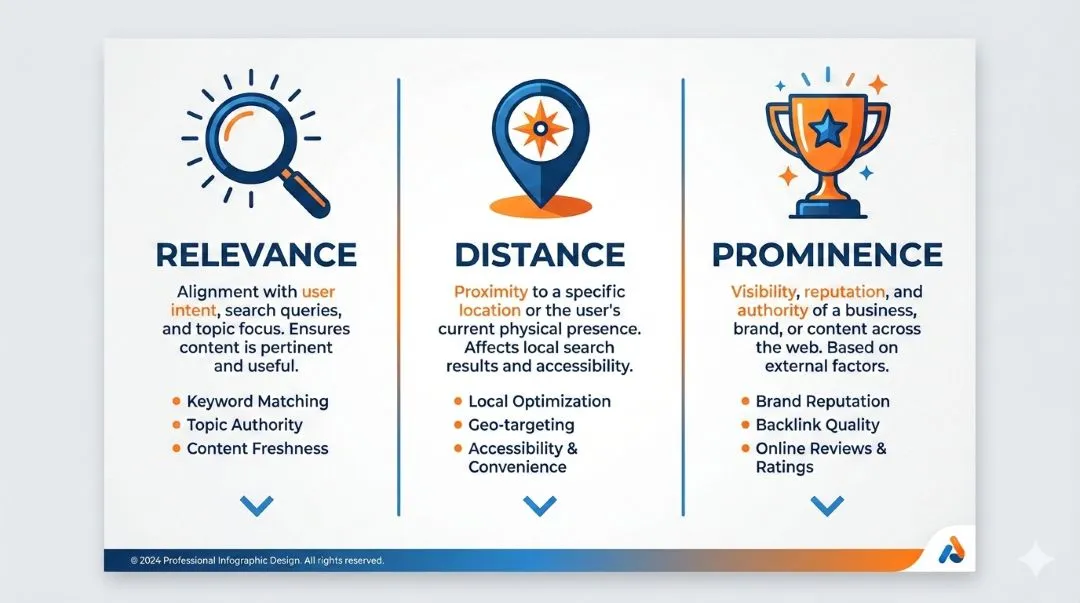 Google uses three primary factors:
1. Relevance: How well your business matches what the searcher wants. Your Google Business Profile categories, services, and description determine this.
2. Distance: How far your business is from the searcher's location or specified area.
3. Prominence: Your business's overall reputation—review quantity and quality, citations across the web, website authority, and engagement signals like clicks, calls, and direction requests.
Google Business Profile Optimization
Your Google Business Profile is the single most important tool for local SEO in Nepal. Most small businesses don't use it correctly.
Essential Optimization Steps
Claim and verify your listing: Search for your business on Google Maps. If it exists, claim it. If not, create one. Google verifies through postcard, phone, or email. Learn more about Google's verification process.
Choose the right categories: Your primary category should precisely match your service. For a beauty parlour, choose "Beauty Salon" not "Beauty Supply Store." Add 3-5 relevant secondary categories.
Complete every section: Fill out business name (your actual legal name, no keyword stuffing), address, phone, website, hours, services, and business description (750 characters describing what you do and who you serve).
Add high-quality photos: Upload 15+ photos—exterior, interior, team, services, products. Businesses with photos get 42% more direction requests.
Take photos that show:
- Your storefront and signage (helps customers find you)
- Interior setup (builds trust before they visit)
- Your team at work (shows professionalism)
- Before/after results if applicable (proof of service quality)
- Products or services in action
Upload photos from a smartphone—they don't need to be professionally shot. Authentic photos showing real work often perform better than stock images.
Post regularly: Share updates, offers, events monthly through Google Posts. They appear in your profile and signal activity.
What to post about:
- New services or products
- Special offers or seasonal promotions
- Business updates (new hours, holiday schedules)
- Events or workshops you're hosting
- Customer success stories (with permission)
Posts stay visible for 7 days, so weekly posting keeps your profile fresh.
Enable messaging: Let customers message you directly. Respond within 24 hours to build trust.
When someone messages, they're often comparing multiple businesses. Fast responses win customers. Set up notifications on your phone so you never miss a message.
Add Q&A: Answer common questions in the Q&A section. This helps customers and reduces repetitive inquiries. Common questions include pricing, parking availability, appointment booking process, and what to bring.
Local Keyword Research
Local keyword research targets buyers ready to act, not information seekers.
Service + Location Keywords
These are your primary targets:
- "Yoga classes Kathmandu"
- "Wedding photographer Pokhara"
- "Orthodontist Lalitpur"
- "Japanese restaurant Thamel"
Blog keywords answer questions like "how to choose a wedding photographer." Local service keywords indicate buying intent: "wedding photographer Pokhara pricing."
Quick Keyword Research Tactics
Use Google autocomplete: Start typing your service + location and see suggestions.
Here's how: Go to Google (not logged in or in incognito mode) and start typing "dental clinic Kathmandu" then pause. Google shows what people actually search for: "dental clinic Kathmandu prices," "dental clinic Kathmandu open on Sunday," "best dental clinic Kathmandu." These suggestions are gold—they're real searches from real people.
Check "People Also Ask": Look at related searches at the bottom of results.
Search your main keyword and scroll to the bottom. "Related searches" shows variations people use. Click on a few results and check the "People Also Ask" boxes that appear. Each question represents search demand.
Review competitor GBP profiles: Note categories and services they list.
Look at businesses ranking in the Maps Pack for your target keywords. What categories did they choose? What services do they list? This shows what Google associates with those searches.
Check your GBP insights: See actual search terms people used to find you.
If your GBP is already claimed, go to Insights. Under "How customers search for your business," you'll see the exact queries that led people to your profile. These are opportunities to optimize for.
Use Google Search Console: If you have a website, GSC shows which queries drive impressions but not clicks. These are keywords you're close to ranking for—optimize for them first.
The key is choosing keywords that match commercial intent, not just search volume. A keyword with 50 searches from buyers beats 500 searches from browsers.
On-Page SEO for Local Service Pages
Your website sends local signals to Google through strategic optimization.
Homepage Essentials
- H1 tag with location: "Premium Dental Care in Lalitpur"
- Opening paragraph mentioning your location and services
- Full NAP (Name, Address, Phone) in footer or header
- Service overview with internal links
Service Page Structure
Create dedicated pages for each major service:
- Homepage: Overview, location, contact
- Service page 1: "Root Canal Treatment in Lalitpur"
- Service page 2: "Teeth Whitening Services Lalitpur"
- Service page 3: "Pediatric Dentistry in Lalitpur"
Each service page needs 500+ words covering what the service is, who it's for, benefits, pricing if appropriate, and clear calls-to-action.
Internal linking: A well-structured internal linking strategy helps Google understand your site architecture and distributes authority across pages.
NAP Consistency
Your business Name, Address, and Phone must be identical everywhere—website, Google Business Profile, Facebook, directories. Inconsistencies confuse Google.
Service Areas
Mention locations naturally: "We provide plumbing services throughout Kathmandu Valley, including Kathmandu, Lalitpur, Bhaktapur, and Kirtipur."
Technical Essentials
- Mobile-friendly responsive design (70%+ of local searches are mobile)
- Page load under 3 seconds
- Clickable phone numbers on mobile
- SSL certificate (https)
Mobile optimization specifics:
Most local searches happen on mobile. Your website must work perfectly on smartphones. Test it yourself: grab your phone, search for your business, visit your site. Can you:
- Read the text without zooming?
- Tap buttons easily (large enough touch targets)?
- Call directly by tapping the phone number?
- Fill out forms without frustration?
- Load the page in under 3 seconds on mobile data?
If any answer is "no," fix it immediately. Use Google's Mobile-Friendly Test tool to identify issues.
Page speed matters: Slow sites kill conversions. Compress images before uploading (use Tin.webp), minimize heavy scripts, and use simple, clean designs. A fast 3-page website outperforms a slow 30-page site.
Clickable contact info: Phone numbers and addresses should be tappable links on mobile. Use:
<a href="tel:+9779841234567">Call Us</a>for phone<a href="https://maps.google.com/?q=YourAddress">Get Directions</a>for address
Implement LocalBusiness schema markup to help Google understand your details. For other helpful resources, check out these free SEO tools.
Local Citations and NAP Consistency
Citations are online mentions of your business name, address, and phone number. They help Google verify your business exists and its location.
Common Citation Sources in Nepal
Essential platforms (start here):
- Google Business Profile (non-negotiable)
- Facebook Business Page (massive reach in Nepal)
- Instagram Business Profile (visual businesses especially)
- Yellow Pages Nepal (still used for local searches)
Secondary platforms (add these next):
- Nepal directory websites (search "business directory Nepal")
- Industry-specific platforms:
- Restaurants: Foodmandu, Zomato, TripAdvisor
- Hotels/Tourism: Booking.com, TripAdvisor, Lonely Planet
- Healthcare: Local medical directories
- Education: Education Nepal platforms
Community platforms:
- Local Facebook groups (Kathmandu Buy/Sell, Pokhara Services)
- Reddit r/Nepal (with genuine participation, not spam)
- Hamrobazaar (for certain business types)
Don't waste time on international directories that Nepali customers never use. Focus on platforms where your actual customers spend time.
The Critical Rule
Use the exact same format everywhere. Don't abbreviate "Kathmandu" as "KTM" on some platforms.
Example of proper consistency:
- Business Name: Himalayan Dental Clinic
- Address: Thamel Marg, Kathmandu 44600, Nepal
- Phone: +977-1-4123456
Focus on Quality Over Quantity
Tier 1: Google Business Profile, Facebook, Instagram, your website Tier 2: Yellow Pages Nepal, major Nepal directories Tier 3: Industry-specific platforms if relevant
Don't waste time on hundreds of irrelevant directories. Focus on platforms Nepali customers actually use.
Reviews and Reputation Management
Reviews influence both customers and Google's algorithm.
Why Reviews Matter
- Review quantity, quality, and recency affect rankings
- Social proof influences buying decisions
- A business with 80 reviews at 4.5 stars outranks one with 5 reviews at 4.0 stars
How to Get Reviews Ethically
Ask at the right moment: Right after excellent service, when satisfaction is fresh.
Timing matters. Ask when the customer just expressed satisfaction: "I'm so glad you're happy with the results!" is your cue. Don't wait days later—the emotional connection fades.
Make it easy: Create a direct Google review link and send via SMS, email, or WhatsApp.
To get your review link:
- Find your business on Google Maps
- Click "Share"
- Copy the link
- Add "/review" at the end
Save this link and use it in follow-up messages. The fewer clicks to leave a review, the more people will do it.
Create a system: Build review requests into your service process. Train staff to ask satisfied customers.
Don't rely on memory. Create a review request workflow:
- Day of service: Verbally ask if they're satisfied
- Same day/next day: Send WhatsApp message with review link
- 3 days later: Gentle follow-up if no review yet
Train every team member. When your receptionist, technician, or service provider asks, it normalizes the request.
Use review cards: Print small cards with QR codes linking to your review page. Hand them out with receipts or completed services. Make it physical and impossible to ignore.
Respond to every review: Thank positive reviews, address negative ones professionally. Customers read your responses.
For positive reviews, be specific: "Thank you for mentioning our quick appointment scheduling, Sita! We're glad we could help with your dental concern."
For negative reviews, acknowledge the issue, apologize if appropriate, and offer to make it right: "We're sorry your experience didn't meet expectations. Please contact us directly at [phone] so we can resolve this."
Never argue in public responses. Take the conversation offline.
What NOT to Do
- Never buy fake reviews—Google will penalize you
- Don't incentivize reviews with discounts
- Don't ignore negative reviews
- Don't only ask happy customers (looks suspicious)
Follow Google's review policy guidelines to stay compliant.
Common Local SEO Mistakes
I've made most of these mistakes myself—some are common SEO mistakes beginners make. Here's what to avoid:
1. Keyword Stuffing Business Names: Use your real business name, not "Best Dental Clinic Kathmandu Lalitpur Affordable." Google penalizes this.
2. No Dedicated Service Pages: One homepage can't rank for multiple services. Create separate pages for each offering.
3. Fake Locations: Google will suspend all your listings. List only your real physical location.
4. Low-Quality Citations: Don't pay for automated submission to 100+ directories. Focus on 10-20 quality sources customers actually use. Quality matters more than quantity—similar to how backlink quality trumps quantity.
5. Poor Mobile Optimization: Most searches happen on mobile. Test your site—ensure it loads fast with readable text and clickable buttons.
6. Inconsistent Hours: Different hours on Google vs reality frustrates customers. Update for holidays.
7. No Updates: Stale profiles signal abandonment. Post monthly, add photos regularly, respond to reviews.
How Long Does Local SEO Take?
Anyone who promises guaranteed rankings in 30 days is lying. Here's the realistic timeline:
1-3 months: Your GBP shows up in relevant searches for less competitive keywords. 5-10 interactions monthly.
3-6 months: You appear in Maps Pack for moderately competitive terms. 15-30 customer interactions monthly from Google.
6-12 months: For competitive industries (restaurants, dental, gyms in Kathmandu/Pokhara), reaching top 3 takes 6-12 months.
Factors Affecting Speed
- Competition level
- Starting point (existing presence vs zero)
- Consistency of effort
- Website quality
- Budget and resources
Local SEO compounds over time. Each review, citation, and piece of content adds to your prominence.
Local SEO Checklist
Google Business Profile
- Claimed and verified
- Primary category accurate
- Business description complete (750 characters)
- Accurate NAP
- 15+ photos uploaded
- Monthly Google Posts
- Messaging enabled
Website
- Homepage includes service and location
- Dedicated service pages (3-5 minimum)
- NAP in footer
- Mobile-friendly, loads under 3 seconds
- LocalBusiness schema markup
Reviews
- System to request reviews
- Respond to all reviews
- Target: 20+ reviews, 4.0+ stars
- Fresh reviews (within 30 days)
Citations
- NAP consistent across Google, Facebook, website
- Listed on 5-10 relevant directories
- No duplicate listings
Tracking
- Check GBP insights monthly
- Track calls and direction requests
- Monitor Google Search Console
Measuring Success
Focus on business outcomes, not vanity metrics.
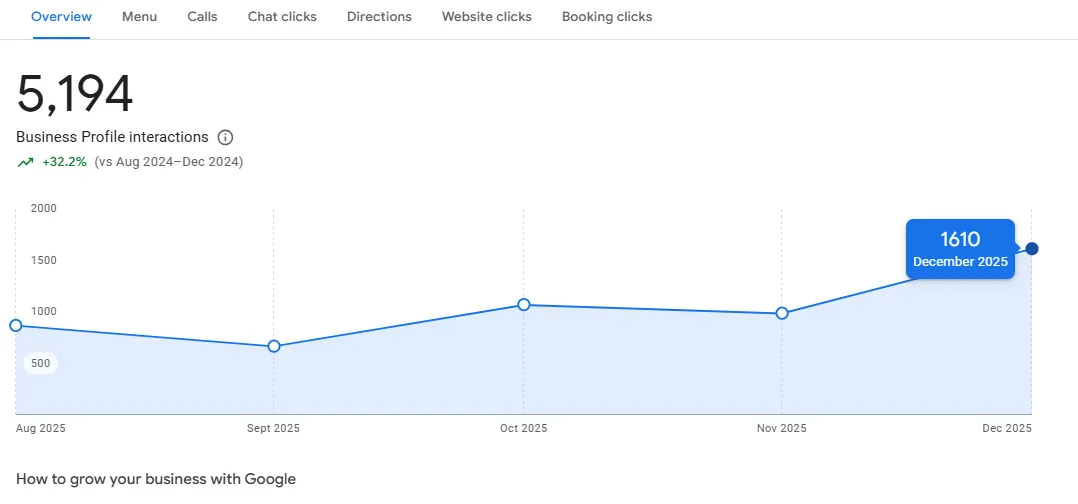
What to Track
- Phone calls from Google Search
- Direction requests
- Website visits from local search
- Form submissions and booking requests
- GBP engagement (views, clicks, searches)
- Actual business outcomes (new customers, appointments, revenue)
How to Track Results
Google Business Profile Insights: Check monthly for:
- Total searches (how many times your profile appeared)
- Direct searches (people searching your business name)
- Discovery searches (people finding you through service searches)
- Views on Google Search vs Google Maps
- Customer actions (calls, website clicks, direction requests)
Compare month-over-month to spot trends. Growing discovery searches means your optimization is working.
Call Tracking: Use a dedicated phone number for your GBP. This tells you exactly how many calls come from Google vs other sources. Even a simple notebook tracking "Where did you hear about us?" works.
Website Analytics: In Google Analytics, check:
- Traffic from Google Organic (includes Maps)
- Geographic location of visitors (should match your service area)
- Pages visited (are local service pages getting traffic?)
- Goal completions (form submissions, calls, bookings)
Google Search Console: Monitor:
- Impressions and clicks for local keywords
- Average position for target terms
- Click-through rate (CTR) improvements
Low CTR despite good rankings means your title/description needs work.
Setting Realistic Goals
Month 1-3: Focus on setup completion, not rankings. Goal: 100% GBP completion, 10+ reviews, NAP consistency across 5+ platforms.
Month 4-6: Expect movement in rankings. Goal: Appear in Maps Pack for 1-2 less competitive keywords, 20+ reviews, 50+ discovery searches monthly.
Month 7-12: See real business impact. Goal: Top 3 for primary keywords, 40+ reviews, 10+ customer actions weekly from Google.
These are guidelines, not guarantees. Competition level varies dramatically.
DIY vs Hiring an Expert
DIY Makes Sense If:
- You have more time than budget
- Low competition industry
- Under 5 employees
- Enjoy learning marketing
Time commitment: 8-12 hours initial setup, 2-4 hours weekly ongoing.
Hire a Professional If:
- Highly competitive industry
- Don't have 5+ hours weekly
- Need faster results
- Have budget (NPR 15,000-40,000/month freelancer, 50,000+ agency)
What to Look For:
- Transparency in explaining what they'll do
- Local Nepal market experience
- Clear progress reporting
- Ethical practices—no fake reviews or guarantees
- Portfolio with real results
If you're considering professional help, reach out to me via the Contact page.
Frequently Asked Questions
Will local SEO work in smaller cities outside Kathmandu?
Absolutely. Competition is lower, so businesses in Butwal or Dharan can dominate faster.
What if competitors have fake reviews?
Report them to Google, but focus on building genuine reviews. Authentic reviews carry more weight long-term.
Do I need a website or just GBP?
You can start with just GBP, but a website significantly multiplies results through more keyword targeting, credibility, and lead capture.
How often should I post on Google Business Profile?
Aim for at least once per month. Weekly is ideal for competitive industries.
Can I rank for multiple cities?
Only if you have a genuine physical location or service area in those cities. Don't fake locations—Google will penalize you.
Want help with your project? Get in touch .