Your Website Gets Traffic but No Sales?
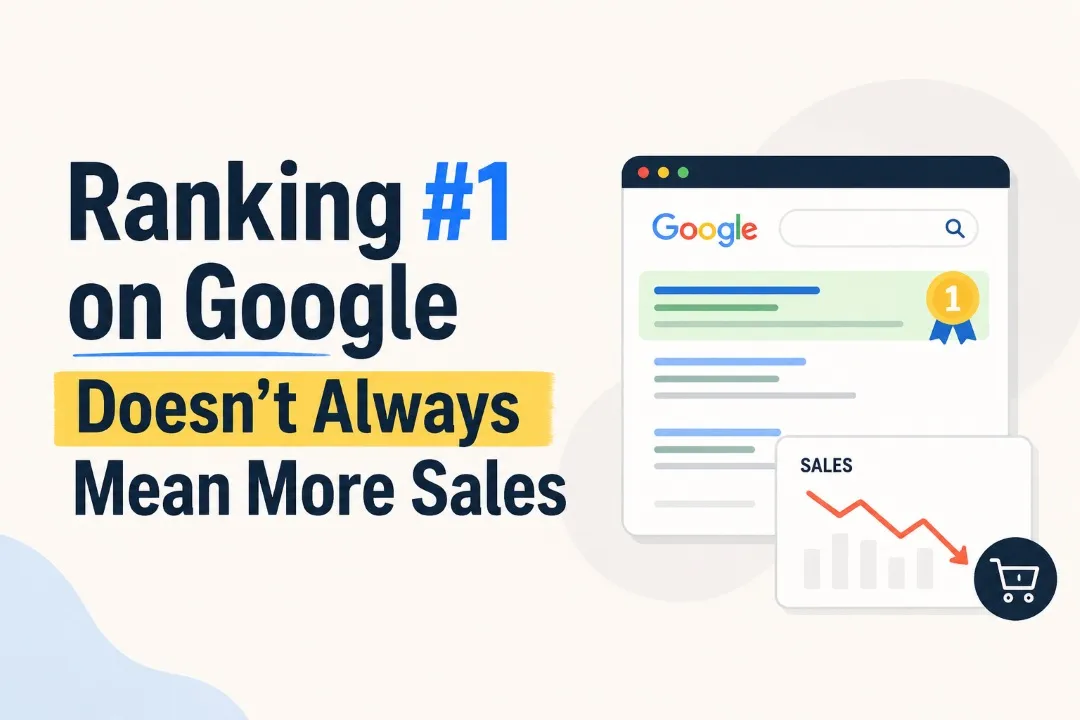
Table of Contents
- SEO Brings Visitors. Your Website Creates Customers.
- 1. You're Attracting the Wrong Audience
- 2. Your Landing Page Doesn't Match What People Expect
- 3. Your Website Doesn't Build Trust Quickly
- 4. Your Website Makes Taking Action Difficult
- 5. You're Measuring Traffic Instead of Conversions
- 6. Your Website Creates Too Much Friction
- How to Turn Website Traffic Into Sales
- Final Thoughts
- Need a Second Opinion on Your Website?
You've invested time and money into improving your website. Maybe you've hired an SEO professional or hired agency, publish quality content consistently, or are finally seeing your pages rank on Google.
The good news? Your website is getting traffic.
The bad news? Your enquiries haven't changed.
If you've even looked at your analytics and wondered, "Why is my website getting visitors but no sales?", you're not alone.
This is one of the most common frustrations businesses face after investing in SEO. Many assume that once their website starts to rank, customers will naturally follow. While that sounds logical, it isn't how online marketing works.
SEO helps people discover your business. It doesn't automatically convince them to buy from you.
Think of it this way. Ranking on Google is like opening the front door of your shop. It gets people inside, but what happens next determines whether they walk out empty-handed or become a customer.
So if your website gets traffic but no sales, here are the most likely reasons—and more importantly, how to fix them.
SEO Brings Visitors. Your Website Creates Customers.
One of the biggest misconceptions about SEO is that ranking higher automatically means more revenue.
In reality, SEO only influences the first step of the customer journey.
Google Search → Website Visitor → Interested Visitor → Lead → Customer
SEO helps someone find your website.
Everything after that depends on factors like your content, website experience, credibility, pricing, offer, and how easy it is for people to contact you.
If any part of that journey breaks, traffic alone won't grow your business.
That's why some websites receive thousands of monthly visitors yet struggle to generate enquiries, while others attract far less traffic but consistently convert visitors into paying customers.
The difference isn't always rankings. It's what happens after the click.
1. You're Attracting the Wrong Audience
Not always a more traffic means better traffic.
One of the biggest reasons websites get visitors but no sales is because they're ranking for keywords that don't attract potential buyers.
Imagine you own a wedding photography business.
Ranking for "best wedding photographers in Nepal" might bring a healthy number of visitors. However, many of those people are simply comparing options, looking for inspiration, or reading recommendations before making any decisions.
Now compare that to someone searching:
- Wedding photographer package in Kathmandu
- Hire wedding photographer in Lalitpur
- Wedding photography price in Nepal
These searches show much stronger buying intent. The person isn't just browsing anymore—they're actively looking for someone to hire.
This is why keyword research should focus on intent, not just search volume.
A keyword with fewer monthly searches but higher commercial intent often generates more business than a broad keyword with thousands of visitors.
Instead of asking, "How many people search this keyword?", ask:
"Is this person likely to become my customer?"
2. Your Landing Page Doesn't Match What People Expect
Even if you target the right keyword, visitors will leave if the page doesn't answer their search.
Suppose someone searches for "SEO services in Nepal."
They expect to land on a page explaining your services, pricing approach, experience, and how they can get started.
Instead, they arrive on a homepage talking about your company's history.
That disconnect creates friction.
Visitors don't want to search your website for answers. They expect Google to send them directly to the most relevant page.
Every important keyword should have a dedicated landing page that satisfies the visitor's intent.
Ask yourself:
- Does this page answer the visitor's question immediately?
- Is the information easy to scan?
- Can someone understand what we offer within a few seconds?
If not, rankings alone won't help.
3. Your Website Doesn't Build Trust Quickly
People make surprisingly fast decisions online.
Within seconds of landing on your website, visitors start asking themselves questions like:
- Can I trust this business?
- Have they worked with businesses like mine?
- Are they experienced?
- Is this within my budget?
- How do I contact them?
If your website fails to answer those questions, people simply return to Google and click another result.
Trust isn't created through long paragraphs about your company.
It's created through evidence.
Show real customer testimonials, genuine Google reviews, case studies, completed projects, certifications, awards, and clear business information.
For local businesses, trust becomes even more important.
A gym in Lalitpur, a hotel in Chitwan, or a digital agency in Kathmandu will often convert better when visitors can immediately see authentic reviews, recent work, and clear contact details.
People don't just buy services. They buy confidence.
Recommended Read: The Complete Google Business Profile Optimization Guide for Local Businesses
4. Your Website Makes Taking Action Difficult
Sometimes businesses lose customers for a surprisingly simple reason.
Visitors don't know what to do next.
You've probably seen websites that end every page with vague buttons like:
- Learn More
- Explore
- Discover
Those buttons rarely encourage action.
Instead, give visitors a clear next step.
Depending on your business, that might be:
- Request a Quote
- Book a Free Consultation
- Get Pricing
- Call Now
- Chat on WhatsApp
- Schedule a Demo
Your contact information should also be impossible to miss.
Don't hide your phone number in the footer.
Don't bury your enquiry form beneath several sections.
The easier you make it for someone to contact you, the more enquiries you're likely to receive.
5. You're Measuring Traffic Instead of Conversions
Many businesses celebrate increasing website traffic.
Traffic is exciting because it's easy to measure.
But visitors don't pay your bills.
Customers do.
Instead of focusing only on sessions and page views, start paying attention to conversion metrics.
Ask questions like:
Which page generated enquiries? Which keyword brought actual customers? Which pages have the highest conversion rate? Where are visitors leaving?
A page that receives 200 visitors and generates 10 enquiries is often far more valuable than another attracting 5,000 visitors without producing a single lead.
Business success isn't measured by clicks.
It's measured by results.
6. Your Website Creates Too Much Friction
Every unnecessary obstacle reduces conversions.
Sometimes it's a slow-loading website.
Sometimes it's a confusing navigation menu.
Sometimes it's a contact form asking for fifteen different details before someone can submit an enquiry.
Small usability problems add up.
Review your website from a customer's perspective.
Can someone:
- Understand what you offer within five seconds?
- Find your contact details immediately?
- View your website comfortably on a mobile phone?
- Load pages quickly?
- Submit an enquiry without unnecessary effort?
Improving user experience often delivers better returns than chasing a few extra ranking positions.
How to Turn Website Traffic Into Sales
If your website gets traffic but no enquiries, use this checklist to identify potential problems.
✔ Target keywords with strong buying intent instead of chasing high search volume.
✔ Create dedicated landing pages that match each important keyword.
✔ Add genuine testimonials, case studies, and Google reviews.
✔ Display your phone number, email, or WhatsApp prominently.
✔ Use clear calls-to-action on every important page.
✔ Simplify enquiry forms by asking only for essential information.
✔ Improve page speed and mobile usability.
✔ Track enquiries, phone calls, and form submissions—not just website traffic.
✔ Review your pages regularly using analytics to understand where visitors leave.
Often, small improvements across several areas produce much better results than trying to rank one position higher on Google.
Final Thoughts
If your website gets traffic but no sales, don't assume SEO has failed.
More often than not, SEO has done its job.
The real challenge begins after someone clicks your website.
Businesses that consistently generate leads understand this. They attract visitors with the right keywords, answer the searcher's questions quickly, build trust through real proof, and make taking action simple.
That's what turns traffic into customers.
So before investing more money into chasing higher rankings, take a closer look at what happens after the click.
You may discover that your next sale isn't hiding on page one of Google—it's waiting behind a better landing page, a stronger call-to-action, or a smoother customer experience
Need a Second Opinion on Your Website?
If your website is already getting traffic but enquiries still aren't coming in, the issue may not be your SEO. It could be your landing pages, keyword strategy, user experience, or conversion path.
I help businesses identify these bottlenecks through practical SEO and website audits focused on turning existing traffic into real business opportunities—not just higher rankings.
If you'd like someone to review your website and point out what's holding it back, feel free to get in touch. I'd be happy to help.
Want help with your project? Get in touch .